Grace Presbyterian Church

A Warm and Welcoming Church


Meditation: Let My Crying Come Unto Thee

Grace Presbyterian Church

December 22, 2019, Blue Christmas

Psalm 102:1-11; James 5:7-10

Let My Crying Come Unto Thee

It was thirty years ago this past Wednesday that my mom died.

It was seven years ago on the 14th that I had one major surgery, and seven months ago this past Friday that I had a second one, the results of which are still an ongoing adjustment I have to make in my life.

When in seminary they tell you that an anecdote is a good attention-getting way to start a sermon, what I just did isn’t what they’re talking about. I think, though, that there are times that there is no good or right formula to begin with, other than to lay bare the fact of human existence – that at some point in our lives, in some way or another, if we have even a tiny shred of humanity about us, we all suffer.  And despite our best efforts to avoid doing so, we all end up learning that, as C.S. Lewis put it, “there is nothing we can do with suffering except to suffer it…”[i].

Now there are books upon books out there that will give you all manner of advice or instruction on how to deal with this kind of thing, and their counsel will not be much like what C.S. Lewis had to say about it. You’ll get language about “overcoming,” for example. Maybe “breaking free.” A favorite exercise of mine is to go on Amazon dot com to look for book titles that include the particular word in question, and when one enters just the word “suffering” here are some of the titles one might get:

  • More Beautiful Than Before: How Suffering Transforms Us
  • Suffering: Gospel Hope When Life Doesn’t Make Sense
  • Suffering is Never for Nothing
  • Suffering and the Heart of God: How Trauma Destroys and Christ Restores
  • Walking With God Through Pain and Suffering
  • 101 Ways to Find Meaning in Suffering
  • Making Sense Out of Suffering

You get the idea. If you’re suffering, whether physically or emotionally or any other way, something is wrong with you for feeling that; or just hold on because this is going to make you into a superhero! (or something); or somehow your faith is off and you need to fix it.

Even the reading from the epistle of James, while it doesn’t go quite that far, begins with the admonishment to “be patient.” I don’t know about you, but in times of grief or pain the last thing I want to hear is to be patient. Like I have a choice, James, come on. There is a time for that counsel, but there is a time not for that counsel too.

As usual when it comes to suffering in scripture, it’s the psalmist who gets it.

For what turns out to be eleven verses in our modern reading of Psalm 102, the psalmist does nothing but pour it all out to God. “Hear my prayer, O Lord; let my cry come unto you.” It starts from there and keeps on pouring out; challenging God to listen and not to turn away from the pain being poured out, not just to listen but to answer. And from there, the psalmist does not hold back.

Some of these images that sound odd to us are fairly commonplace in this style of Hebrew; we would speak of them as metaphors or similes, means by which the speaker’s own grief and distress can be expressed in the most vivid and affective terms possible. Some of them, like verse 9’s image of eating ashes like bread and mingling tears with drink, are found elsewhere in the Psalms as well. The psalmist does not care how weird or pathetic he (or she) sounds; it only matters that God hears, nothing else.

For all of the preachers and scholars and others who have pored over the Psalms over the centuries, it is my suspicion that the one who “got” this psalm most of all was not one of them, but a composer. The great English Baroque composer Henry Purcell set out, we think, to create a choral setting of this psalm; we have to say “we think” because Purcell’s setting, as far as we know, never got beyond that first verse – as the King James Version Purcell would have used renders it, “Hear my prayer, O Lord, and let my crying come unto thee.” Those are all the words used. But by bringing his own technical skill to the text – using voices at the extremes of their vocal range, eight different voice parts overlapping and echoing one another, letting the volume rise and fall and rise but never letting the music come to rest – Purcell interprets the verse into a surging, overwhelming act of pleading, crying out indeed to the Lord to be heard, to be able to voice the grief and the suffering of the psalmist.

It’s not clear if Purcell was somehow prevented from setting the rest of the psalm, or if indeed the one verse was all he meant to use. My personal suspicion (or hope) is that once he had completed that much, he knew there was nothing more he could say.

Whatever else may come, whatever may happen after the onset of the suffering or grief, the first thing to be done, as C.S. Lewis might say, is to suffer it. Not to hide it or try to conquer it by sheer willpower or any such thing, but to pour it all out before God. Hear my prayer, we say. Let my crying come unto thee. We cry out, and we trust that God indeed will hear.

For the God who truly hears our prayer, Thanks be to God. Amen.


Hymns (from Glory to God: The Presbyterian Hymnal): #797, We Cannot Measure How You Heal; #824, There Is a Place of Quiet Rest


Music During Meditation:

J.S. Bach, Prelude in C, BWV 846

Frederic Chopin, Prelude in C minor, op.20

Edward MacDowell, Woodland Sketches, op. 51: “To a Wild Rose”

Amy Beach, “Canoeing,” op. 119 no. 3

Edvard Grieg, Lyric Pieces, op. 12; no. 3, “Watchman’s Song”


[i] From A Grief Observed.


Sermon: Rejoice

Grace Presbyterian Church

December 15, 2019, Advent 3A

Luke 1:46-55; Isaiah 35:1-10; James 5:7-10; Matthew 11:2-11

Rejoice

A conversation that happened in the church office this past week has stuck in my head while preparing this sermon. While Sherry Crane was in the office on Tuesday, she wondered aloud to Ivette Cardoso, our administrative assistant, and me whether Christmas was somehow managing to sneak up on us this year. I had to admit it felt true, and due to the nature of my job I have to think about Christmas well in advance. I could easily see how it might feel “all of a sudden” to others who don’t have to start thinking about Christmas in October or so.

But then, it’s almost impossible not to start thinking about “Christmas,” in some ways, isn’t it? Thanksgiving got conquered long ago, and Halloween put up a good fight but now it seems to be increasingly overwhelmed by the commercial build-up to “Christmas,” by which I mean the holiday shopping season, Christmas movies starting to show up on certain TV cable channels, and some radio stations starting to play Christmas music. I guess Labor Day is next to fall. Anyway, given that relentless commercial pressure that starts building up so early (far, far beyond what Charlie Brown fretted about in that famous Christmas special), I suppose it can seem like a shock when the actual holiday itself is upon us all of a sudden.

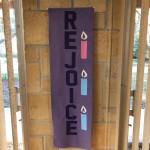
The pink candle that was lighted today on the Advent wreath almost serves as an alert signal. While the rest of the candles on the outside of the wreath are purple, befitting the liturgical color of the season, the candle to be lit on the third Sunday of Advent is instead pink. This is a means of pointing to the particular nature of some of the scriptural texts for the day, texts which contain expressions of joy at the ongoing work of God and of the promises to be found in God’s ongoing words to the people of God.

Take today’s responsive reading, for example, the wonderful song known as the Magnificat, sung by Mary during her visit to Elizabeth at that time when both were pregnant with highly unexpected and unconventional sons. The joyful tone is set right away, from the very opening statement “My soul magnifies the Lord, and my Spirit rejoices in God my Savior.” The song goes on to sing of how God has blessed his servant Mary, and to describe more generally attributes of who she calls the Mighty One.

Now admittedly there are those for whom Mary’s song might not sound terribly joyful: the proud, who are “scattered…in the thoughts of their hearts”; the powerful, “brought down…from their thrones” as the lowly are lifted up; the rich, “sent…away empty” while the hungry are filled. If you’re one of those, then perhaps the pink candle isn’t for you. But as Jesus notes in the reading from Matthew, “the poor have good news brought to them” (we’ll get to that more later), so perhaps we should simply acknowledge that Mary’s song here fits quite nicely with what her son would define as part of his mission and his call. So, joyful indeed is this song of Mary, a good incipit to the Sunday of rejoicing. One might even say that it is the most Advent thing in all of the gospels, if not perhaps in the entirety of scripture; it is that strong a statement of the coming reign of God, and one of which we could stand to remind ourselves often.

But let’s get back to that Matthew reading. The little snippet quoted above comes from Jesus’ response to messengers from John the Baptist, who is in a far different state than he was in last week’s reading, when he was preaching and baptizing in the wilderness and giving religious leaders some serious reprimanding. By this time John has been arrested and thrown in prison for having the gall to tell Herod, the Roman-sponsored ruler over Judea at the time, that it was wrong for him to take his brother’s wife for his own (although we don’t get that story until Matthew 14, told retroactively).

Being imprisoned has a way of breaking a person, and John seems to have suffered its effects. Since their first meeting in Matthew at Jesus’s baptism, it was pretty likely that John had kept tabs on what Jesus was doing. In fact, in Matthew 9 we see an encounter in which some of John’s disciples ask Jesus why he doesn’t engage in regular and frequent fasting, as John’s disciples (as well as Jesus’s sometime adversaries the Pharisees) did. John had taken up a rather ascetic life in the wilderness (remember the camel-hair coat and locusts-and-honey died), while Jesus traveled freely from town to town and city to city and was known to join in a banquet or two. Feeling the strain of imprisonment, and knowing that most folks who entered Herod’s prison didn’t leave alive, he began to experience something that not at all characteristic of his public ministry: doubt. And so he sends some of his own followers to Jesus to ask, “are you the one…or are we to wait for another?

At first, Jesus’s answer might seem to chide John or his disciples, just slightly. He gives a rundown of what’s been going on – sight restored, mobility restored, health restored, hearing restored, life restored, hope restored, when you break it all down. And then there’s that little shot at the end: “And blessed is anyone who takes no offense at me.” This could sound like a slight at his older cousin, but then there were probably folks in the audience of the moment to whom such statement could have been directed as well.

At any rate Jesus goes on to show that insulting John was far from his point, noting that “no one greater than he” was to be found among humanity. But still, the moment of doubt is telling. Is John simply worried that his time is nearly done, or is there concern about how Jesus is going about his ministry in a very different and seemingly less, well,holy way than John had lived out his call? Was Jesus not living right enough for John?

As Jesus will note later in the chapter (vv. 18-19), both Jesus and John get picked on by the Pharisees; of John and his ascetic life they say “he has a demon,” and Jesus gets called “a glutton and a drunkard” for his non-fasting. You can’t win either way, so it’s probably best not to get into some sort of holiness Olympics with each other. But perhaps even more the point is that, for all the awfulness and injustice of John’s situation, Jesus’s ministry is still healing and restoring and bringing good news to the poor. Sadly, as long as we live on earth, we will not all know joy at the same time; one experiences true joy while another faces tragedy. But one’s tragedy does not eliminate another’s joy (again, more on that later). All of those being healed and restored are still joyful.

Meanwhile, there is a similar dynamic at play between today’s other two readings, from Isaiah and James. Isaiah brings the joy, in what might be the most over-the-top of the readings assigned for Advent from this book. Right away the image of the desert blossoming and rejoicing takes us to a place we aren’t accustomed to seeing, at least not without an astronomical amount of rainfall to set off the desert bloom. The passage also includes encouragement for the fainthearted, and a short insert that sounds a bit like Jesus’s description of his own ministry in verse five, where “the eyes of the blind shall be opened and the ears of the deaf unstopped.” But the predominant images are of the desert and wilderness, with waters breaking forth, streams in the desert, pools and springs and even swampland breaking out. Imagine Palestine turning into Florida, in other words.

If Isaiah says “the desert will blossom,” James responds “you’ll have to be patient.”

If anything, the time in which we live is characterized by the opposite of what Isaiah describes; lands that once were fertile turning barren and fruitless under the pressure of a rapidly heating planet. Even normal lands, James reminds us, don’t bloom or produce fruit without water, and lots of it. James engages in his own bit of agricultural metaphor to remind his readers that patience in waiting for the coming of the Lord is a must. What he describes is not unlike what takes place in the growing of crops like wheat in the central part of this country. First you need rain – the “early” rain – to make the soil ready to bear and nourish the seeds that are to be planted. Then you need rain – the “late” rain – to enable the seeds to ripen and grow to maturity.

If you’re not that farmer, though, the coming of those rains might be more hassle that hope. It ruins our plans, maybe, or just makes it a hassle to get around town or to work that day. And indeed the rain can be bad for that farmer, too, if it comes too early or too late or too much or not enough at a time. But in God’s economy, the rains come as meant to come, and we wait patiently for them, and in this is joy. So it is with this Advent (second Advent, if you will) for which we wait.

For all that we like to toss around the word this time of year, we often have trouble with what it means to rejoice, or even to know joy. We far too easily confuse it with pleasure or happiness. Those two sensations can admit of no counterweight; the moment one feels pain, one no longer feels pleasure. Happiness is taken down by sorrow. Those two cannot endure under such pressures.

Joy is different, and rejoicing as these scriptures suggest is also different. In the words of author and Christian apologist C.S. Lewis (in his memoir Surprised by Joy), “All joy reminds (emphasis mine). It is never a possession, always a desire for something longer ago or further away or still ‘about to be.’”  Joy knows sorrow, and does not pretend that sorrow is not there. Joy recognizes that the crazy vision promises of Isaiah’s prophecy are still in the distance, that the rains must come, and we still live in a world where injustice and cruelty have sway. Joy even motivates us to act against injustice and cruelty because joy knows that what we most desire cannot tolerate those things. Joy knows its incompleteness. That’s a thing that comes up in John’s gospel a few times, as in John 16:24, “Ask and you will receive, that your joy may be complete” – it isn’t completed now, it is to come.

It’s a complicated burden for this pink candle to bear. Joy does not rejoice only in what is but in what is to come. Pleasure is easily thwarted, happiness crumbles at the coming of sorrow, but joy endures knowing itself to be not yet finished. Like this empty stable without a nativity, like the family with the empty place at the table that wasn’t empty a year ago, like the farmer waiting for the rains, joy knows its unfinished state; and yet still joy, and those taken by joy, rejoice in the babe to be born, the manger to be filled, the knowing that in the ultimate and final coming of the Savior – that babe yet to be born to Mary, that teacher John suddenly wasn’t sure about – in that second Advent there our joy will, at last, be full and complete.

Let that pink candle be our wake-up call; let it be our reminder that Christmas is suddenly near; but let it also call us, in spite of…even though…nevertheless…to rejoice and be glad.

Thanks be to God. Amen.


Hymns (from Glory to God: The Presbyterian Hymnal unless otherwise noted): #88, O Come, O Come, Emmanuel (stanzas 1-4); #—, See, the Desert Shall Rejoice; #100, My Soul Cries Out With a Joyful Shout (Canticle of the Turning); #88, O Come, O Come, Emmanuel (stanzas 5-7)   


1 Comment

Sermon: Prepare

Grace Presbyterian Church

December 8, 2019, Advent 2A

Isaiah 11:1-10; Psalm 72:1-7Romans 15:4-13; Matthew 3:1-12

Prepare

The description is from Isaiah 40:3. Because Matthew apparently refers to the Septuagint, the very early Greek translation of Hebrew Scripture that would have been highly circulated in his time, his quotation is slightly different from what you’d find if you looked up Isaiah 40:3 in your pew Bible. Still, it’s the same bit of prophetic outcry that was made famous by Handel in one of the early solos in his oratorio Messiah [note: it’s around 2:15]:

The voice of him that crieth in the wilderness:

Prepare ye the way of the Lord!

Make straight in the desert a highway for our God.

If Broadway is more your speed, you might remember the opening song from the musical Godspell, first sung by a solo singer, then eventually by the full cast.  Pre-ee-ee-pare ye the waaaay oooooffff the Lord…..”

It’s a catchy little bit of prophecy, you might say, and easily set to music.

It is also in some ways a high point of a panel of readings that come togther on this second Sunday of Advent. The responsive reading we spoke together gives a glimpse into the people’s yearning for a just and righteous king. From the very beginning of the psalm we hear the plea for a ruler who embodies and enacts two things that were far too often lacking in the kings of Israel and Judah: justice and righteousness.

You can read, back in the eighth chapter of 1 Samuel, how at a time when Samuel the prophet was getting old and his sons weren’t living up to his legacy, the people of Israel took their grievances to Samuel, complaining and asking to have a king “to govern us, like other nations.” As God pointed out to Samuel at the time, it wasn’t Samuel the people were rejecting, but God’s own kingship over them. Nonetheless God told Samuel to give them what they wanted.

Suffice it to say that by the time of both the Psalms and Isaiah readings, the people had experienced plenty of opportunity to regret that choice, even if they never admitted it. The psalm reading demonstrates clearly what the people had given up in rejecting God’s rule all those years before. Justice and righteousness were absent from their rule far too often, oppression ran rampant, and the poor and needy were defenseless and abused routinely. The psalmist pleads for a king who rules with justice and righteousness, with favor for the needy and oppressed – in other words, a king who ruled the way God ruled.

The account from the prophet Isaiah comes from an even more stark and bleak perspective. By this time Israel and Judah have both been conquered, and their leaders, unjust and unrighteous as they were, turned out also to be quite powerless and incompetent in the face of those kings the people of Israel (the ones Israel had apparently been jealous about back in Samuel’s time). The people of the two kingdoms saw their rulers hauled off like common prisoners and humiliated, sometimes brutally, before all the enemies of Israel and Judah. Rather than becoming a big and tough and powerful kingdom standing tall on the world stage, Israel and Judah had become laughingstocks. Imagine that; putting your trust in a human leader only to be humiliated and become a joke to the world.

Given that devastating experience of the consequences of rejecting God’s leadership, the prophetic oracle recorded here in Isaiah 11 is remarkable indeed. Jesse of course refers to the father of David, so pretty clearly the promise is of one from David’s line emerging as a true ruler, in not only David’s lineage but in God’s own path, an exuberant hope indeed. The promise of a leader upon whom God’s spirit rests, characterized by wisdom and understanding and good counsel and might and knowledge and fear of the Lord, one who judges in righteousness – yes, there’s that word again – and favors the lowly and meek – another repeated idea; again this promise is coming from Isaiah at a particularly bleak and seemingly hopeless time in the history of the two kingdoms that were once one.

The sheer overwhelming hopefulness of this promised leader then leads to this ind-twisting, yet characteristic image from Isaiah; a world in which the things we think are fixed and unchangeable no longer hold. Predators and prey live at peace, and not at a safe distance like at a zoo or a Disney park. Wolf and lamb, leopard and baby goat, calf and lion, cow and bear, are being together all cozy and comfy. Lions don’t prey; they graze. Children can play with snakes and not be hurt. (This is where I insert the warning: don’t try this at home, children.) Even nature is repaired and restored by this Promised One.

Of course, by the time we get to the events of Matthew’s gospel, centuries have passed and neither the king sought by the psalmist nor the branch of Jesse’s family tree proclaimed by Isaiah have come along. Exile has ended and come again, and after many years the Roman Empire has established its rule over the people of what once had been Judah and Israel. Those words still rang in ears of the people, though, and more than a few would-be prophets had sought to tickle the ears of the people claiming to be the long-awaited deliverer, only to find out what happened to those who dared challenge the Roman Empire (they disappeared quickly).

So when the word started to get around about this guy preaching out in the wastelands away from Jerusalem, maybe it was a hopeful thing for some. Might this possibly be “the voice of one crying in the wilderness” from Isaiah 40? Or maybe there was a mixture of hope – “maybe this is the one” – and cynicism – “oh, boy, here we go again” – in the reaction of the folks in the city. Whatever their reaction, they came out to see him. And what they saw, as it turned out, wasn’t anything like they expected.

For one thing, he would admit that – unlike so many of these wannabe prophets – he wasn’t preaching about himself, as he himself admits starting in verse 11. For another, well…look at the guy. That’s not a normal wardrobe. And munching on wild locusts and honey adds to the look. Also, he’s not really promising the kind of things the folk were hearing in the psalms and the prophets. No glossy visions of predators and prey at peace, no idealized versions of a coming ruler are found here; John’s message is pretty one-note. The note is this: “Repent, for the kingdom of heaven has come near.” That’s it, as far as Matthew records.

The kicker is yet to come. John’s message does change on one occasion: when the religious leaders started showing up. Anyone who thought John was a odd but fiery preacher got something new to see and hear.

By the time of Matthew’s gospel, it was pretty well-established that the religious leaders of Jerusalem were, to put it bluntly, collaborators with the occupying Romans. It was a calculated thing to be sure; cooperate, and maybe fewer people get hurt. Go along and get along, don’t let any trouble get started, and everything stays peaceful (and you get to keep your power to some degree). This would have been less the case outside the city. At any rate, hearing this crazy guy in the camel-hair coat rip into the religious leaders as soon as they got within earshot of him probably had its own particular entertainment appeal as far as this wilderness-preaching scenario went.

Still, this? Really? This is the prophet? This is the setting? No beautiful sweet Hallmark-card visions of wolf and lamb lying down together? No idealized vision of a just and righteous leader to rescue us all? Just “repent,” and some guy coming with a winnowing fork and baptizing with fire somehow? You might not know whether to be amused or slightly disturbed.

No, it doesn’t appear that God chose a very traditional prophet to be “the voice of one crying out in the wilderness.” And the message delivered by this unconventional messenger felt a bit darker and less hopeful. Still…maybe? By this time any hope was something. But what to do about it?

Well, repentance sure seems necessary. That level of self-examination and change of life – not merely saying sorry for your sins, but changing your life so as not to live in that sin anymore – seems to be a first and indispensible step in preparing for the Promised One, for the reign of God come near. John’s not ambiguous about it, and the message especially seems to apply to those who would seem to be at the top of the food chain, so to speak – those who claim, or are trusted with, any kind of spiritual authority. It’s fearful stuff to contemplate from this pulpit, you can be sure of that. But nobody is off the hook; the call to “repent” is for all who seek the One to come.

What else? Maybe we take our clues from the early church, the folks to whom Paul (among other apostles) was writing and preaching and teaching. These are, after all, our ancestors in the life of Advent as a two-way street – living in the wake of the first Advent while longing for the second.

Mind you, “Christmas” had not, so to speak, been invented yet. It wasn’t a big huge festival occasion for the early church the way it is today (for one thing, no one agreed on the date). But certainly the birth of Jesus was a known part of their theology and learning – the Savior born of a human, born like one of us, was as an essential a part of the church’s understanding then as it is now. And at the same time, those Romans and others to whom Paul was writing were also waiting, perhaps with even greater, more imminent expectation, for the return of that same Jesus. While by the time of this letter to the church in Rome it was becoming clear that such return wasn’t going to happen quite as quickly as Paul had hoped, it was still something he expected and taught the churches he visited and experienced to expect as well.

So what was expected in living the perpetual life of preparation for that Advent? Well, be steadfast, have hope, and be encouraged by the scriptures. Live in harmony “in accordance with Christ Jesus,” and glorify God by doing so. Welcome one another – Gentile as well as Jew as things stood in the Roman church, fulfilling the word of the prophets that this Promised One was promised for all. These all seem simple, or maybe not. Hope is hard to come by. Harmony is a challenge. Welcome seems quite countercultural these days. And yet living in preparation seems to involve these things, somehow.

Preparing, and being prepared, doesn’t have quite the same ring here as it does in the world around us. Being prepared, if it’s not being used as the Boy Scouts motto, can take on a darker tone these days. You have to have health insurance and life insurance to be prepared for your health to fail; you have to put in a massive security system to be prepared for someone to try to break into your home; you have to stock up on supplies to be prepared when a hurricane is coming. But Advent is not about preparing for a threat; it is about preparing for hope, for the reign of God to come near, for the fulfillment of all that has been promised. We may not get petting zoos where wolves and lambs cavort together, but we do await, and watch for, and prepare for that reign of God to come. Let us prepare, and live prepared.

Thanks be to God. Amen.

Hymns (from Glory to God: The Presbyterian Hymnal unless otherwise indicated): #106, Prepare the Way, O Zion; #—, Prepare Your Hearts; #96, On Jordan’s Bank the Baptist’s Cry; #105, People, Look East


Sermon: Watch

Grace Presbyterian Church

December 1, 2019, Advent 1A

Isaiah 2:1-5; Romans 13:11-14; Matthew 24:36-44

Watch

“Watch therefore: for ye know not what hour your Lord doth come.”

The old words of the King James Version of verse 42 of Matthew 25 conjure up an image that is developed in many different sources, including that first hymn we sang today – “Watchman, tell us of the night.” The image of a guard, possibly a lone guard, keeping watch from a tower over the bleak, dark night, watching for who knows what? Invaders? Lost travelers? Wild animals?

The NRSV version in your pew Bibles and that I read a few moments ago goes with the translation “Keep awake,” which may likely be slightly more accurate but doesn’t have quite the air of vigilance as that word “watch.”

Another advantage, I have come to believe, is that while the instruction to “keep awake” certainly makes sense in the context in which Matthew was writing, I’m not completely sure that it speaks to the situation in which we read the scripture today. Keep awake? Frankly, I have the strong suspicion that all of us could stand to get a little more sleep.

But keeping watch? Now there’s a challenge. We live in an age in which distraction if the order of the day. I started to say “busy-ness” there but I’m not even sure that quite catches the correct meaning. We live in a world that seems bound and determined to go off the ledge, and our own country might well be leading the way. There are more multiple-victim shootings per year than there are days of the year. We seem bound and determined to melt the polar icecaps at both ends of the planet, which just might bring oceanfront property to Gainesville. And yet with these and many other crises, wars and rumors of wars all about us, we manage to keep pretty well distracted. Sports (which don’t always promote a lot of good will), social media (which often seems determined to seek the opposite of good will), an entire entertainment industry devoted to distraction by whatever means necessary, and many more shiny things compete for our attention, leaving us not very watchful.  (And I didn’t even mention Black Friday.)

And on this first Sunday of Advent, this is the world, a world that can barely keep track of its own attention, into which Jesus says “watch, therefore.”

What, then, are keeping watch for?

Matthew’s recounting doesn’t initially seem all that helpful. It does begin with the helpful remonstrance that no one, not even Jesus, knows when all this is to come to pass – “about that day and hour no one knows, neither the angels of heaven, or the Son, only the Father.” It isn’t merely about waiting out the night, or waiting for the holiday with relatives pouring in; whatever this is, we do not know when it will be.

And what, exactly, is all this for which we keep watch? Well, back at the beginning of the chapter, the disciples got a private meeting with Jesus to ask “what will be the sign of your coming, and of the end of the age?”, so we know we’re getting into that end-of-time stuff that isn’t extremely comfortable to talk about. Some of the persecutions and tribulations in the chapter seem to refer, in retrospect, to the things that happened at the time of the Roman conquest and destruction of Jerusalem and the temple. Other sections, including today’s reading, seem more pointedly eschatological – referring to the end of times. And the clues offered here are fairly bleak; a reference to the time of Noah, with, as you might recall, the Great Flood wiping out a large swath of humankind (which is a lovely story to tell our children); cryptic sayings about two working and one being taken; a thief breaking in during the night.

Not exactly the stuff of rejoicing, on the surface. On the other hand, if you’re the one living under the thumb of the empire (the owner of the house, so to speak), maybe the Son of Man breaking in at an unexpected hour to undo the bondage of empire does sound a lot more hopeful.

Still, Isaiah’s poetic prophecy sounds a lot more joyful, yes? All the nations of the earth streaming to the mountain of the Lord to learn the ways of God; weapons of war beaten and broken into farm implements; yes, that’s the stuff of rejoicing. Yet somehow we take both of these words, the prophetic utterances of both Isaiah and Jesus and hold them in tension, and learn why we are to keep watch and what we are to keep watch for: the ultimate in-breaking of the reign of God, and un-doing of the broken and destructive ways of fallen humanity.

The reading from Romans may seem an odd fit, but here we are reminded of the hard truth that keeping watch (or being awake, whichever you prefer) doesn’t happen unless we put aside those things that distract us. Again, we are good at finding so many things to distract us, and they certainly don’t have to be the big obvious vices that Paul names out to his Roman readers and hearers. Being sober and living clean itself does not guarantee watchfulness with so many other possible distractions available to us.

Whatever that distraction is, we really have to lay it aside in order to keep watch, whatever it is for which we do keep watch. It requires a trust we don’t do well; trust that the day and hour do not have to be solved to our satisfaction for the coming of the Son of Man to be our hope and our salvation, nearer now than when we became believers.

Keep watch.

Thanks be to God. Amen.


Hymns (from Glory to God: The Presbyterian Hymnal unless otherwise noted): #97, Watchman, Tell Us of the Night; #—, Keep Watch; #384; Soon and Very Soon; #83, Come, Thou Long-Expected Jesus


Sermon: How to Think Thankfully

Grace Presbyterian Church/Covenant Presbyterian Church

November 27, 2019, Thanksgiving

Philippians 4:4-9

How to Think Thankfully

“…think about these things.”

Whoa, Paul, careful with statements like that. You want to be more cautious about the company you keep.

The whole business of telling people how to think or what to think or some other variant on the concept is the kind of thing that gets used, frankly, to sell stuff. The always-fun exercise of using good ol’ auto-complete in your web browser on Amazon.com, for example, yields some of these chestnuts:

Think and Grow Rich – a title I remember mostly from very annoying television commercials and even infomercials.

Or how about this subtitle from the Chicken Soup for the Soul series – “Think Positive, Live Happy.” That could have been an infomercial all by itself.

Then there’s Thinking, Fast and Slow, a title all about how our brains work with instruction on tapping into the more deliberate part of our mental processes, which leads us towards the variant of this genre that specifically starts “how to think.” For example:

Two different books with the title How to Think About God, one a combination of two writings by the ancient Roman stoic philosopher Marcus Tullius Cicero, the other a more modern volume by Mortimer J. Adler.

How to Think Theologically, a volume that is occasionally put before new seminarians, also comes up. It’s now into a third edition, so evidently somebody out there thinks it’s important.

Getting away from religion, there’s How to Think About Money (I apologize, I said ‘getting away from religion’), How to Think Like Leonardo da Vinci, How To Think Like a Roman Emperor, and probably the best and most worthwhile of the bunch, How to Think Like a Cat. Anything that gets humans to wait on you hand and foot has to be worth considering, right?

This kind of “thinking about thinking,” so to speak, doesn’t just show up in book titles for that matter. Take, for example, one of the songs from the Broadway musical (and movie) The Sound of Music. You know the one. In the movie, after the von Trapp children get frightened by that thunderstorm and Maria sings to them something about raindrops on roses and whiskers on kittens, bright copper kettles and warm woolen mittens…and it ends up “I simply remember my favorite things, and then I don’t feel so bad…

In no way will I claim that I’ve read those books, but the song I will give credit for getting one particular aspect of all this right: in order to have the desired result (not feeling so bad when the dog bites or the bee stings), the pattern of thought (remembering her favorite things) has to be cultivated. It doesn’t just happen. If one of us gets stung by a bee it’s going to hurt and we’re going to feel, probably, well beyond “bad” (or far worse if one is allergic), and simply remembering my favorite things isn’t going to be the first idea to pop into my head, unless that habit of mind has been deliberately cultivated. You have to decide to do it, so to speak.

If you were wondering how all of this could possibly connect with this reading from Paul’s letter to the church at Philippi, there it is.

We’re getting near the end of the letter, and as is not atypical, Paul launches into a final series of encouragements as he comes to a close. The language is fairly typical at first; that exhortation to “rejoice in the Lord always; again I will say, rejoice” has parallels in many of his other letters. Instruction about how to show one’s faith, instead of merely talking about it, is also fairly common, as in verse five’s encouragement to “let your gentleness be known to everyone.” The encouragement to pray is also common and unsurprising.

Where this wrap-up pep talk gets interesting is in verse eight. Here, in this seeming list of adjectives out of nowhere, Paul is getting down to the business of the habits of mind that go into the Christian life. And by the way Paul gives this instruction, Paul clearly indicates that these things don’t just happen; such habits of thought have to be developed and cultivated.

When we spend time in deliberate reflection on “whatever is true … honorable … just … pure … pleasing … commendable” or on the things that are excellent or worthy of praise, there are a lot of possible outcomes. One of those is certainly applicable to tonight’s occasion: Thanksgiving, or gratitude (if you want to use a more theological-sounding word). To think with deliberate attention and observation on these particular virtues brings us to greater awareness and understanding of the God in whom such virtues originate and who through Christ makes it possible for us even to approach such virtures in our own lives and hearts. So yes, such a pattern of thought and reflection might be a good start on a new self-help bestseller, “How to Think Thankfully.” But again, such reflection doesn’t just happen; it has to be chosen and engaged deliberately and intentionally. The habit has to be cultivated, again and again.

There is something about which we need to be careful in approaching such a pattern of reflection and cultivation of habit. The results might not lead us where we expect.

True, a greater sense and expression of gratitude (or thanksgiving) is a pretty likely result of such reflection, but it is not the only such result. Let’s look back at verse seven to remind ourselves of how this list of virtues has been set up. After all the instruction about rejoicing and not worrying and being in “prayer and supplication with thanksgiving” (see?), we get this sentence: “and the peace of God, which surpasses all understanding, will guard your hearts and your minds in Christ Jesus.

It sounds like a nice conclusion to verses six and seven, and it is. That is not, however, all that it is. It’s a bridge of sorts; it serves both the ideas that come before it and the ideas that come after as well. So after we do all the praying, the peace of God will guard our hearts and our minds in Jesus. As the peace of God guards our hearts and our minds in Christ, we think on what is true, honorable, just, pure, pleasing, commendable, excellent, and praiseworthy, we then do these things, the things that Paul himself has striven to show the Philippians in his behavior towards them. It isn’t about just a peaceful and thankful mind or heart; it shows up in how we work and act and speak and do and live as well. It’s not a passive thing, but an active and even animating thing as well. We don’t just think differently, we act differently as well.

As if that weren’t disturbing enough, that activating and animating tendency might even lead us into places we might not go otherwise. When you start to contemplate those things that are true, honorable, just, pure, pleasing, commendable, excellent, and praiseworthy, you can’t avoid noticing those things in the world around you that are not true, honorable, just, pure, pleasing, commendable, excellent, and praiseworthy. Even worse, it might no longer be possible to avoid noticing those things that are not true, honorable, just, pure, pleasing, commendable, excellent, and praiseworthy in yourself.

And if the God of peace is truly guarding our hearts and minds in Christ, well, guess what? Those things are no longer going to be acceptable. You might find yourself in a spot where you have to speak up, to insist that the church or the nation or the world or, most frightening of all, your own self must be better, must be true, honorable, just, pure, pleasing, commendable, excellent, and praiseworthy.

This may not be the stuff that makes your auto-complete function fill up your browser window with happy-sounding things that make you want to buy them. And it might sometimes make you something other than happy. After all, do we really want to be happy about lies, or dishonor, or injustice, just to name a few? But here’s the thing; those same things also grieve God’s own heart. And if we’re seeing these same anti-virtues in the world and knowing the same grief and heartbreak and maybe even anger at them as our own God feels, maybe we are just a little bit closer to that God we claim to worship and to serve. And I would hope we would find that something truly to be thankful for.

So no, if you’re looking for a mind perpetually at ease and free of care, this may not be the prescription or exhortation for you. But if you can live with a heart marked with true gratitude for what God has given, that also knows what it means to live most fully in the mind of Christ even if it hurts, this may be a path to follow. If you’re ready for a thankful mind that leads to a thankful life, even if it’s a little bit challenging life, then indeed think on those things that are true, honorable, just, pure, pleasing, commendable, excellent, and praiseworthy. And indeed, the God of peace will be with you.

For the invitation and opportunity to think thankfully, Thanks be to God. Amen.


Hymns (from Glory to God: The Presbyterian Hymnal): #336, We Gather Together, #659, Know That God Is Good (Mungu ni nwema); #654, In the Lord I’ll be Ever Thankful; #643, Now Thank We All Our God


Sermon: Both Ways

Grace Presbyterian Church

November 17, 2019 (Joint Worship ServIce of GPC and Gainesville Korean Presbyterian Church)

Acts 8:26-40

Both Ways

My years at Union Presbyterian Seminary in Richmond, Virginia coincided with the last years Syngman Rhee spent there. Rhee was the widely respected religious leader who, after having to flee North Korea at the outbreak of the Korean War, became among other things a Christian educator pastor, a mission director for the United Presbyterian Church, a leader in the National Council of Churches, and a moderator of the Presbyterian Church (USA) General Assembly in 2000. He had spent a number of years at Union before retiring, but still frequently found his way into the life and work of the school. After his death in 2015 the seminary established the Syngman Rhee Global Mission Center for Christian Education in his honor.

My main memories of him come from two chapels in which he participated while I was there. Preaching at one service, he somehow made his way in his message to the song from the movie version of The Sound of Music, “Something Good”, when Julie Andrews and a soundtrack singer dubbed in for Christopher Plummer sang:

Nothing comes from nothing, nothing ever could

So somewhere in my youth (or childhood), I must’ve done something good

As he continued, the moment quickly became a giant sing-a-long, as the whole chapel – seminary students and faculty, visitors from a local Korean congregation, everybody – was singing along. When it was done, Syngman Rhee added a comment that was perfect for a seminary congregation: “Great song. But bad theology!”

The other moment came from a moment in the service of the Lord’s Supper. He began the observance of the sacrament with a common Invitation to the Table, found in PC(USA)’s Book of Common Worship, which opens:

Friends, this is the joyful feast of the people of God!

They will come from east and west, and from north and south,

And sit at table in the kingdom of God.

Again, it was a common liturgical formula; I had probably heard it dozens of times by this point in my seminary career. But it was different, at least for me, this time.

He began the prayer, in his deliberate and precise English. All was normal, you might say, until he came to say “They will come from east and west, and from north and south…” He paused, and said again, even more deliberately, “North … and South…”

If you were connected to Union at all, you knew Syngman Rhee and his background. It might have been something that happened every time he led the Lord’s Supper, for all that I know, but for those of us who hadn’t heard that moment before, never had those words – North … and South – resonated quite so powerfully as when spoken by this man who knew from hard first-hand experience what it meant for North and South to be separated, unable to come to the table together.

The oft-repeated and theologically correct assertion that we are all one in Christ should never be allowed to cloud our recognition that we come to the table of communion, or the table of feasting and fellowship as we will after this service, with vastly different experiences of the world, or to forget how our faith is driven and challenged by those different experiences of the world. It would be extremely arrogant of me to expect a Christian, even a fellow Presbyterian, to have exactly the same faith experience as me when that person has come from a situation such as that which produced Syngman Rhee. Open warfare between north and south in this country was more than a hundred and fifty years ago, not merely sixty-six years. One Lord, one faith, one baptism, yes, but that faith speaks many different languages and lives and learns many different stories.

For all of that, it seems like the Lord likes it that way. Indeed, today’s reading from Acts almost seems to suggest that God deliberately made it happen that way.

The Philip who appears in today’s reading was not the disciple by that name, rather, he was one of the seven “deacons” who were appointed earlier in Acts when the size and diversity of the emerging Christian community in Jerusalem was getting too large for the disciples to handle. In one of the most dismissive-sounding verses in all of scripture, Acts 6:2 records that the disciples wanted the community to choose seven from among themselves because “It is not right that we should neglect the word of God in order to wait at tables.” One of those seven chosen was Stephen, who became the first Christian martyr in chapter 7, and another was this Philip, who was among the many Christians scattered due to the wave of persecution that broke out after Stephen’s death. He had ended up in Samaria, that rival region in which Jesus had broken all sorts of taboos by speaking with a woman at a well. Philip had proclaimed the good news there and many had believed, so many that the disciples sent Peter and John to look into what was going on.

In the end, the Lord gave Philip an odd set of instructions: to go south, out into a wilderness, and wait by a particular road. Strange and unsafe as that must have sounded, Philip did so, and sure enough a big fancy chariot came by. Its passenger was a high court official to a queen of the “Ethiopians” (at that time a term for pretty much all of sub-Saharan Africa, including but not limited to the region of modern-day Ethiopia, a region that represented the known boundaries of the world as far as many in the first century Mediterranean basin knew). The Lord tells Philip to go up to the chariot, and he does.

It turns out this Ethiopian treasurer was reading from Isaiah, a passage at its most basic about someone unjustly killed. When the illustrious traveler asks who this might be, Philip’s mind says, “unjustly killed? I know who that sounds like!”, and he proceeds to tell the story of Jesus. By the time the chariot comes to an unlikely water source, the Ethiopian is all ready to get baptized, and Philip does the job. The Ethiopian heads home rejoicing, while Philip “found himself” at a town called Azotus, where he kept on preaching. We never hear of the Ethiopian again.

On the other hand, one of the earliest places for Christianity to take root, outside of the Mediterranean basin where most of Acts takes place, was that region of sub-Saharan Africa in and around modern-day Ethiopia. Hmm. Christianity has been in Ethiopia about seven times as long as the United States has existed. And the Lord sure seems to have done a lot of intervening to get that to happen. Also, none of the original twelve apostles was involved. On the other hand, Philip, one of those commissioned to “wait on tables,” turned out to be a key messenger in fulfilling Acts 1:8 – “you will be my witnesses in Jerusalem, in Judea and Samaria, and to the ends of the earth” (emphasis mine).

Our Ethiopian treasurer, as far as we know, took his newly-found faith home with him, and became a seed, maybe one of many, of what has been one of the most enduring Christian traditions on earth.

The Christian church in Europe for centuries, and in the United States as well, has had a bad habit of assuming that a Christian church, no matter where it might be planted, was somehow not “real” unless it looked at least somehow like or somehow did the same things or sang the same songs or preached the same way as the church “back home.” The good and right urge to proclaim the good news to all the world often got mixed up with the less salutary urge to reproduce and replicate the same church in this new place as was back in the home country.  We weren’t always good at letting the Spirit do its work, we here in this country.

Now the situation is different. The rapidly shrinking church in Europe really doesn’t have much claim to tell the church anywhere else in the world how to do anything, and the church in this country is now at a point where it should probably do a lot more listening and maybe less telling. We need to listen to a church that knows what it is to be in a state of war for nearly seventy years across a common border; we need to listen to a church, like that in the Philippines, that has seen some of the world’s largest and deadliest typhoons roar across its territory again and again and again on a planet gone completely out of whack; to a church like that in Cuba and numerous other countries, finding a way to survive and keep worshiping under the rule of a hostile dictatorship; we need to listen to the whole church and remember that we are not the whole church.

We need to listen, because it is God’s doing and God’s desire, apparently, that the church be this way – a crazy quilt of nations and peoples flung across the world, with all the different languages and all the different songs and all the different prayers in the service and foods at the table of fellowship. When missionaries and doctors and witnesses of all types spread across country and world, it is the Spirit leading and fulfilling that vision of the whole of humanity in all its messy and confusing glory.

And our job is to enjoy it and glorify God for it, to celebrate and give thanks to the God who gives salvation to all without regard to the borders and barriers we create.

It was sixty years ago that the scholar and hymn writer Erik Routley wrote of the need to re-cast the relationship of the European-American church and the church in South America, Africa, and Asia as one of partnership rather than paternalistic missionary endeavor.[1] The need for this re-conception remains as strong as ever. Our two churches stand as partners in the work of proclaiming the Lord’s name; one church does not lord it over the other. The more quickly we learn the street really does run both ways, the sooner our witness will grow.

For partnership in faith and witness, Thanks be to God. Amen.


Hymns (from Glory to God: The Presbyterian Hymnal): #839, Blessed Assurance, Jesus Is Mine!; #625, O Lord My God (How Great Thou Art); #383, Dream On, Dream On; #103, Come Now, O Prince of Peace (O-So-So)


[1] Erik Routley, Ecumenical Hymnody. London: Independent Press. 1959. 1st ed. Contains the substance of an address which was given to the Council of British Missionary Societies at Edinburgh House on 2nd November 1956.


Sermon: That’s Not How This Works

Grace Presbyterian Church

November 10, 2019, Pentecost 22C

Luke 20:27-38

That’s Not How This Works

A few years ago, an insurance company ran a commercial set among a group of women who, we might say, would fit comfortably into the general age demographic of this congregation. One of the women was boasting about how, instead of mailing pictures of her vacation photos to all her friends, had saved herself time by posting them on her wall. Of course, a first thought to the social media-savvy might suggest she had posted them on social media of some sort, possibly Facebook or Instagram. Instead, the camera pans slightly and you see that the pictures are, literally, taped to the wall of her living room. One of the other women pipes up that she likes one in particular, but the third, one presumably more knowledgeable about such things, looks back and forth between the two incredulously. When the first woman boasts about having an insurance-related achievement in fifteen minutes, this third one retorts that she only needed half that time, to which the first responds, with a dramatic gesture, “I unfriend you.” Finally the third can’t take it anymore and, gesturing around the room, exclaims, “That’s not how this works. That’s not how any of this works!”

It would not at all have been out of line for Jesus to respond in exactly that same way to the question put to him by the Sadducees in today’s reading from the gospel of Luke.

The setting here is in Jerusalem, as we approach the climax of Jesus’s earthly life and ministry. It’s the type of scriptural text that the framers of the Revised Common Lectionary like to slip in toward the end of the liturgical year, a text that at least in some way looks forward to the life not of this earth but of eternity, or heaven or however one frames it.

In this case that particular framing comes from a faction in the religious society in which Jesus lived that didn’t even believe in such a thing. The Sadducees, a competing group to the Pharisees about whom we hear so much, are lingering on the edge of a conversation in which Jesus has just smacked down a group of scribes, or their lackeys as verse 20 suggests, with the response famous in its old King James rendering as “Render unto Caesar the things that are Caesar’s, and unto God the things that are God’s.” That group has beaten its hasty retreat, to the hooting and derision of the crowd, and this group of Sadducees steps up for its at-bat.

As verse 27 informs us straightaway, the Sadducees “say there is no resurrection.” This puts them at odds with the Pharisees, and is a product of their particular interpretation of what constituted “scripture.” While the Pharisees, for example, took the prophets and the Psalms as authoritative, the Sadducees only read the books of the Torah that way. The prophets and Psalms speak in at least some degree of resurrection, the Torah does not; therefore the Sadducees and Pharisees disagree. While Jesus butted heads with Pharisees often, on this point they were in agreement.

The Sadducees’ question is admittedly an absurd one, which relies on a particular allowance of Mosaic or Torah law. If a man died childless, his wife was expected to be married off to the next available younger brother, in theory as a means to provide for the widow, but frankly mostly so that the brother might produce a son to ensure the first brother’s legacy. In this trap question, the poor woman was put through seven brothers, each of whom failed to produce a son; when the hypothetical woman died, the Sadducees ostensibly wanted to know, whose wife would she be in the resurrection?

One could point out a lot of things about the beliefs inherent in such a question. One thing that cannot be overlooked is that it’s pretty clear that to these questioners a woman in such a situation is little more than a piece of property, more a subjected and captive character from The Handmaid’s Tale than a living, breathing human being and child of God and daughter of Abraham. The only thing that matters about her is whose possession is she for all eternity.

This all has to be qualified with words like “hypothetical” and “ostensibly” because in fact this batch of Sadducees weren’t really all that concerned with the answer. At the risk of including a second social media reference in the same sermon, they are trolling Jesus. The very asking of the question was its own end, namely mocking not even Jesus necessarily, but their Pharisee rivals and their oh-so-ridiculous beliefs about life after death.

The trouble is that these Sadducees, unlike modern social media trolls who can disappear in an instant and not be held accountable for the evil that they do, could not get away fast enough. In the end, they were just as humiliated as the scribes who got tripped up on the tax question. In the world of social media, one of the most common and usually best pieces of advice is “don’t feed the trolls,” or in other words don’t give anyone who is clearly engaging in bad faith attacks a forum for their lies. Jesus isn’t most people, of course, and he is quite well-equipped to drive these trolls back under the bridge.

First comes the harder lesson, one that we modern Christians might well have trouble with. This is where the potential “that’s not how this works, that’s not how any of this works” response comes in.

To sum up as best as possible, marriage is a mortal concern. People marry because for most folks, going through life with a partner is easier and more pleasant than going through life alone. That’s a pretty succinct nutshell argument for why marriage is a thing at all in the eyes of God, going all the way back to the Garden of Eden and God’s remark that it wasn’t a good thing for Adam to be alone. This matters because, to put it in as stark a term as possible, we’re going to die, all of us at some point, and such time as we have to endure on this earth go better if we can endure it with someone we love.

Those who share in the resurrection, on the other hand, are never going to die. Life is eternal in the presence of the Eternal One. The concerns of that old past mortality, worries about property and legacy and all that implied in the question, simply don’t matter. In that life the hypothetical woman is in fact a child of God and a daughter of Abraham, subject to no one else.

As much as we might not want to admit this, we don’t like the sound of this, not one bit.

Think about it. What kind of songs, for example, do we sing about Heaven? One example I can’t get out of my head is an old gospel number called “Mansion Over the Hilltop.” Perhaps you remember this one, maybe from Elvis’s version?

I’m satisfied with just a cottage below

A little silver, and a little gold

But in that city where the ransomed will shine

I want a gold one that’s silver lined

 (Refrain:)

I’ve got a mansion just over the hilltop

In that bright land where we’ll never grow old

And someday yonder we will never more wander

But walk on streets that are purest gold

The second verse goes on to talk about wanting “a mansion, a harp, and a crown”. The question of what to do with a harp for all eternity aside, cue the lady from the commercial: That’s not how this works. That’s not how any of this works.

The song does get one thing right; in that bright land we really will never grow old. Otherwise, the metaphor Jesus uses in John 14 (another King James concoction, the one about “In my father’s house are many mansions”), the one meant to communicate how the disciples do not have to worry about life after resurrection because all is provided and there’s room for everyone, gets hardened and fixed into a dogma that we can all pre-order our gold mansions for all eternity. I wish I were exaggerating more than I am, but I’ve seen it up close too many times.

All such things miss the point. Whether the Sadducees intended it or not, this encounter really is about the resurrection, and the resurrection is about God, and being in communion with God and with all who are in communion with God. The resurrection is not merely an extension of this life with better building materials; it is about being in resurrection with the God who has loved us and redeemed us in Christ. This is illustrated by the second part of Jesus’s response to the Pharisees, the one in which he uses their beloved Torah against them by citing the words of Exodus 3:6, right out of the Torah that the Sadducees cited as the only true scripture. When God speaks to Moses out of the burning bush, God doesn’t say “I was the God of Abraham, Isaac, and Jacob back when they were alive”; God puts it all in present tense. “I am the God of your father, the God of Abraham, the God of Isaac, and the God of Jacob.Am. Present tense. Jesus elaborates that God is “God not of the dead, but of the living; for to him all of them are alive.” If God is their God, then they aren’t dead. Their lives are held in God, thus they live and shall live, and somehow that will hold true for us too.

How does that work? Beats me. Paul expended a lot of time and energy in his epistles trying to reassure the Thessalonians and the Corinthians about what resurrection meant and how it related to earthly life, which was to say not much. We get phrases like these from 1 Corinthians 15: “flesh and blood cannot inherit the kingdom of God, nor does the perishable inherit the imperishable”; or from “we shall not all die, but we shall all be changed”; or “for this perishable body must put on imperishability, and this mortal body must put on immortality.” How? Paul doesn’t even go there, nor does Luke, and I’m not going to either. But this is the work of God in us, redeeming us in Christ and preparing us through the Holy Spirit that when our time comes, when death comes upon us, it will not be the final word. What is mortal puts on immortality, and lives in the grace of our Lord Jesus Christ, the love of God, and the communion of the Holy Spirit, really forever and for all time.

We human beings are wildly insecure. We have a terrible habit of substituting rigid belief for life-giving faith. We demand to know how it all works – witness all those preachers and pseudo-Bible scholars who insist on trying to calculate the date of the Rapture when even Jesus says he doesn’t know the day nor the hour. We don’t trust at all, when you get down to the heart of us. Are we ready to take Jesus seriously, and be “the living” that Jesus calls us to be now – to do Christ’s work in God’s world – and trust that our resurrection life is secured in God? Can we do that?

We are mortal creatures, subject to all the finitude and brokenness and decline that is the lot of all mortal creatures. But that is not our final fate, no matter whether we know how it works or not.

For the God of the living, Thanks be to God. Amen.


Hymns (from Glory to God: The Presbyterian Hymnal): #353 My Hope Is Built on Nothing Less; #371, New Songs of Celebration Render (Psalm 98); #822, When We Are Living; #840, When Peace Like a River


Sermon: Ragged Saints and Right Gifts

Grace Presbyterian Church

November 3, 2019, Pentecost 21C (All Saints)

Luke 19:1-10

Ragged Saints and Right Gifts


Short people got no reason

Short people got no reason

Short people got no reason to live…

If it weren’t for the fact that Randy Newman didn’t write this minor novelty song until 1977, you might have to wonder if Zacchaeus heard this song one time too many in his life.

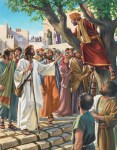
It’s not enough that Luke makes a big deal of Zacchaeus’s being a tax collector. In the culture Luke describes pretty much all along the way in Jesus’s life, being a tax collector was a surefire ticket to being hated and despised by, well, pretty much everybody. Even only a chapter before, in one of Jesus’s parables, we find a tax collector being lumped in with some pretty awful sinners – thieves, rogues, adulterers – by a super-righteous Pharisee. But that wasn’t enough; Luke had to tell the world Zacchaeus was so short he had to embarrass himself climbing a tree to see Jesus over the crowd.

But there’s something else true about tax collectors in Luke’s gospel; Jesus spends an awful lot of time with them. One of the first followers he calls is the tax collector Levi, the one known as Matthew in other gospels. After Levi is called, he gives a great banquet for Jesus, and a whole bunch of tax collectors show up. It becomes enough of a thing that the Pharisees complain about it; “why do you eat and drink with tax collectors and sinners?” becomes their question as early as 5:30, and it apparently becomes a common enough complaint that Jesus refers to it in 7:34:

For John the Baptist has come eating no bread and drinking no wine, and you say, “He has a demon”; the Son of Man has come eating and drinking, and you say, “Look, a glutton and a drunkard, a friend of tax collectors and sinners!”

 It actually works out pretty well for Zacchaeus to show up on this Sunday, both for the observance of All Saints’ Day in many churches and also as our own stewardship campaign approaches its climax. There is one hymn we could have sung today, the one that starts “I sing a song of the saints of God, patient and brave and true” and goes on to describe just how wonderful and perfect those saints are as well as all the jobs they did (not to mention the one who “was slain by a fierce wild beast”!). You can go remind yourself of that hymn at #730 in your hymnal.

There’s just one problem, though; more often than not our saints have a ragged backstory to them, rather like our Zacchaeus here. When Luke tells you not only that Zacchaeus is a tax collector, but also that he’s rich, you’re being led fairly strongly to gather that those riches were ill-gotten, as was rather often the case with tax collectors of the era working for the Roman Empire.

The catch is, though, that Zacchaeus is hardly the only such saint in our heritage. We get a suggestion in the hymn we will sing after this sermon and before the Lord’s Supper, #506, “Look Who Gathers at Christ’s Table!” Even as the “ancient followers appear” there in verse 2, we hear their own confessions of guilt and failure: “Peter tells of his denying Christ was ever in his sight; Paul relates his fruitless efforts to obliterate the light…” These are hardly the only such stories we could find in the Bible to demonstrate the clay feet upon which the saints walk. When we’re honest about it, we see that the saints in our own lives have their own feet of clay, and were, like we are, ragged sinners in need of forgiveness.

And as to that other occasion being marked today, isn’t it interesting that upon his encounter with Jesus, the first thing we hear Zacchaeus say is that he’s going to make right whatever financial wrong he has done? Or how, when Jesus called Levi, even as he gave that great banquet, he also walked away from all the wealth his tax-collector work provided?

It seems that when these ragged saints came face-to-face with Jesus, one of their first impulses was to know what was wrong with themselves in terms of wealth and possessions, and not only to know but to act on that understanding.

Those saints in our own lives, or more particularly those saints in the life of this church, seem to have been of similar mind. This is a small church, which I know pains many of you to hear, but it is not a poor church. The saints of Grace Presbyterian took care to leave behind a church that was well-supported and on a sound foundation. We would do well to follow their example.

That call to faithful stewardship also extends beyond the windows and walls of this church. Too many in our society have no chance, economically. When we go serve meals at Family Promise or St. Francis House, for example, many times meals need to be set aside for residents who haven’t gotten off work yet, sometimes from one of two jobs, and yet they’re homeless. We simply cannot hide behind some presumption that wealth equals virtue. Our resources must go out to meet those needs in the world, if we want to be able to face and follow Jesus at all with anything like Zacchaeus’s response.

Even the most ragged saints make their way to providing the right gifts. Whether or not we feel like saints, we can give like them. Thanks be to God. Amen.


Hymns (from Glory to God: The Presbyterian Hymnal): #326, For All the Saints; #708, We Give Thee But Thine Own; #506, Look Who Gathers at Christ’s Table!; #726 , Will You Come and Follow Me


Sermon: Decently and In Order

Grace Presbyterian Church

October 27, 2019, Reformation

1 Corinthians 14:26-33, 37-40

Decently and In Order

There are, in the broader life of the American church, two running jokes or maybe punch lines about Presbyterians. Or maybe three, if you count how quickly you can get a crowd of Presbyterians to call out “and also with you” just by saying “The Lord be with you” loudly enough for everybody to hear, but that happens in other denominations too. I know, it’s a little strange to think that there’s really anything funny about us, but hear me out.

One of the punch lines, more reflective of an “outsider” view of Presbyterians, is less a joke than a rather cold two-word description of us (supposedly). Maybe you’ve heard it? You know, how Presbyterians are all emotionless and unexpressive? That we’re … (wait for it) … the “frozen chosen”? Yeah, it’s an old one that somehow refuses to go away. Now if it meant we got special tickets for the big Disney movie premiere coming up about a month from now that might be something, but sadly that’s not how it works.

The other punch line, more of an “insider” view, might be regarded as a somewhat more kindly spin on the “frozen chosen” line. No, we’re not frozen, we might say, but we do believe in doing things “decently and in order.”

Hey, that sounds familiar. In fact, we just heard it in the last verse of our reading from Paul’s first letter to the Corinthians. So we’ve got the Bible on our side after all.

All joking aside, churches in the Reformed tradition do in fact have a history of taking that particular fragment of scripture pretty seriously. It shows up in our form of governance, which was in fact a model for the organization of the different branches of government of the United States.

The order of worship today also reflects this concern for order. It is based on an order that was reconstructed about ten years ago to commemorate the five hundredth anniversary of the birth of John Calvin, the scholar and teacher who became the chief voice of theology in what came to be known as the Reformed tradition of the Protestant Reformation. Calvin was not the first such voice, far from it, but his formulation of ideas about theology and worship and the life of the church proved to be most influential and substantially accepted among voices in this tradition. (Reminder: it was John Knox, a Scottish student and follower of Calvin, who brought those ideas to Scotland, where they took root and grew into the tradition we now call Presbyterianism.)

Calvin certainly had ideas about worship, some of which have not been observed in our usage of today’s service. In the midst of searching for a new organist we’re not about to shut off the organ down for the day over a five hundred-year-old ban, for example, nor is the choir being shut down. Also, the songs we have sung in today’s service do mostly comply with his edict that only scripture was to be sung in worship, either psalms (as two of the songs we sang) or other appropriate selections (as the final song we will sing later). The one exception we are making there is, irony of ironies, for a text long attributed to John Calvin himself (although it’s not completely clear that he actually wrote it). To be fair, Calvin’s attitude about congregational singing did soften, just slightly, later in his career, but it is his early restrictiveness that endures as his reputation.

Otherwise note how much the service focuses on the word, or perhaps more accurately on words and on the person preaching them. It’s not clear that anyone besides the preacher presided in worship, so Clint got the day off from liturgy duties. Beyond the traditional use of the Apostles’ Creed, it was expected that the Ten Commandments were to be recited as well, either following the absolution from sin, as today, or after the creed itself. While we have spoken the Confession of Sin corporately and read the psalm in our usual responsive fashion, it’s not clear that either one would necessarily have been encouraged or expected in the churches of the early Reformed tradition. The preacher talked a lot, and everybody else…listened, and that was doing worship “decently and in order.” Oh, and one other thing; at least until the councils of Geneva nixed it, Calvin’s services would have included communion every week.

I guess choirs were considered disorderly? And really, that third song we sang earlier sounds awfully dance-like for a church all consumed with keeping order. For all of that, our more usual weekly worship is not dramatically different from this aside from the greater use of music. Things might be in a slightly different order, some elements are named differently, some things are missing, and the Ten Commandments have not persisted. (Personally, if I were starting a new tradition, I’d have gone with the Beatitudes – words of Jesus, after all – before the Ten Commandments, but that’s just me.)

But, if we’re going to get all excited about Paul’s words, maybe we should look at just what Paul was describing as doing worship “decently and in order,” right? It actually looks a bit different.

Look what is presented right away: “When you come together, each one has a hymn, a lesson, a revelation, a tongue, or an interpretation…” Whoa. Every person in this group somehow was expected to be prepared to contribute something to the worship of the gathered assembly. And it was not just about one person dragging in their favorite hymn every week and demanding that the assembly sing it every week. People were creating hymns or lessons for the assembly. These things – hymns, lessons, revelations, and so forth – were products of the Spirit’s work on the people on an ongoing and ever-renewing basis. Are you prepared for that?

Oh, and let’s get back to that “so forth” – tongues and interpretations, since Paul has a little more to say about that. If it happens, he says…no more than two, maybe three, and make sure they take turns properly – no one stepping all over another’s time. Frankly that’s good advice for speaking in a known tongue, much less an unknown one. And oh, yes, if there’s no one to provide an interpretation of what is to be spoken in tongues, then the potential tongues-speakers need to keep it to themselves (and God).

Then come the prophecies and revelations (we might think of sermons), and again it’s not meant to be a free-for-all. Two or three prophets might speak, one at a time, and the whole assembly – all the women and men, nobles and slaves gathered together – are charged to weigh and evaluate what is said. If one of the assembly is given a revelation by the Spirit in that moment, that one is apparently encouraged to speak, but otherwise even the prophets can take turns and wait for one to finish (and the assembly to weigh what is said) before another starts.

What kind of chaotic order is this?

The key, it seems, is found in verse 26 and verse 33; “Let all things be done for building up.” “For God is a God not of disorder, but of peace.” The gathering of the assembly for worship and instruction is not about who can come up with the best hymn this week, or who has the best revelation or fanciest tongue or cleverest interpretation. If these things are not offered all together for the purpose of building up the body of Christ, for instructing and encouraging and maybe admonishing as needed, then they are out of line. All the fuss about “order” is directed towards one purpose; allowing everybody gathered together the opportunity to hear, to reflect, to respond, and all in all to be edified. Jumbled discourse, one person piling on after another without any sense of order and organization, does not edify, and Paul figured that out.

This was apparently something the Corinthians struggled with. You might remember that elsewhere in this letter Paul has to reprimand the Corinthians for their conduct of the Lord’s Supper, which included a meal that some people got into early and ended up full and drunk and some ended up with nothing to eat – a pretty disordered way of doing such service. So being concerned with keeping things orderly and edifying makes sense in this case, and it’s not unreasonable that the church reformers of the sixteenth century would also be concerned about that.

We have to observe, however, that even the most orderly service does not necessarily edify or build up. An orderly service can be nothing more than ego-boosting for a power-hungry pastor, for example (and yes, those do exist). It can be a means of stifling any kind of individual thought in favor of hardened doctrine based on half-baked and hateful Bible-thumping and bad interpretation, which does happen sometimes. It can be, in the hands of the worst, a forum for emotional and spiritual abuse, with the obedient listeners being pounded repeatedly with their own awfulness and God’s unrelenting judgment, with no hint of God’s love or mercy.

Order isn’t everything. What the order is used to communicate matters. If order is nothing more than a synonym for “control,” then we are guilty of actively clamping down on the moving of the Holy Spirit. Seriously, if I (or any preacher) thinks that my words are all that matter in a service of worship, I need to quit. That’s not what this is for.

If our order is about anything other than building up, edifying, offering the opportunity to learn and pray and take in and respond and all of those things that equip us to be servants of Christ; if our worship is about anything besides that, we’re doing it wrong, and we should probably close up shop and head home. Chaos doesn’t edify anybody, but order itself is not the answer. What we say and do and sing matters, and matters intensely.

Obviously Calvin’s directives about worship eventually loosened up, even if only after his death. Eventually the church decided, for example, that hymns written by human beings inspired by God (you know, the way that human beings inspired by God wrote the Psalms) could be good for worship. Still, the Reformed tradtion maintains, for the most part, a concern for doing things “decently and in order,” and that’s all fine and good, as long as what we do with that order, and who we serve with it, matter more than the order itself.

For doing things “decently and in order,” and with love and mercy, Thanks be to God. Amen.


Hymns (from Glory to God: The Presbyterian Hymnal): #624, I Greet Thee, Who My Sure Redeemer Art; #385. All People That on Earth Do Dwell; #261, Peoples, Clap Your Hands!; #545, Lord, Bid Your Servant Go in Peace


Sermon: Covenants

Grace Presbyterian Church

October 20, 2019, Pentecost 19C

Psalm 119:97-104; Jeremiah 31:27-342 Timothy 3:14-17

Covenants

Continuing a theme of hope found in last week’s reading from Jeremiah (even if not all of Jeremiah’s readers would have found it hopeful), the reading before us today speaks words of promise to the exiled people of Judea. And also as in last week’s reading, the words of hope are also words with an edge; in this case the hope comes with a renewed understanding of the responsibility of those with whom God chooses to be in relationship, and even to engage in the making of a new covenant.

In this passage, though, there’s a different wrinkle to be found, and it involves the odd little metaphor of old saying found in verses 29-30. It’s a curious metaphor that might not resonate well with us today, since by the time any grapes we get show up at the local supermarket we count on any bad ones having been weeded out long before. But the lesson of this old saying, which is being overturned in God’s message through Jeremiah, deserves a closer look.

In this old saying “The parents have eaten sour grapes, and the children’s teeth are set on edge,” we get a lesson on how this era viewed responsibility for generational sin. This particular bit of folk wisdom held that not only the generation that was unfaithful to God, but the generations that followed, were guilty of that unfaithfulness and subject to punishment for it. In this case the sin of the previous generation, the rampant infidelity to God and embrace of idols among the people of both Israel and Judah, had been stated many times over in Jeremiah’s prophecies up to this point, and his audience was living with the consequences of that infidelity in their Babylonian captivity.

But now, as Jeremiah proclaims, that old folk wisdom does not hold true. Just as God’s promise here includes bringing the land of Judah and Israel back to full life as in the first verses of this passage, so God’s promise sets the current generation free from being punished for the sins of the previous generation. You eat the sour grapes, your teeth are set on edge. This does not set any generation free from righting the wrongs of previous generations, mind you; no generation is ever immune from God’s mandate to do and demand justice and to make wrongs right, no matter who first perpetrated the injustice. But as far as responsibility goes for sins against God, you bear it for yourself.

And in this case, that “you” goes two ways. Never ignore that in the large majority of scripture “you” is a plural form of address. God speaks, through the prophets to all the people of Israel or Judah or both. Paul’s epistles are written to churches comprised of many people. Many of Jesus’s discourses are to full crowds following him around the countryside. You, as noted a few weeks ago, means “y’all.”

Here, though, there is an individual dimension. A nation or a generation, after all, is made up of individuals. It becomes the responsibility of each individual, therefore, to do her or his part for their nation or generation or church to live in fidelity to God and to the covenants God has made with the people of God.

That brings us to a word that comes up a good bit in scripture, but might bear a bit of exploration. “Covenant” gets defined in the Merriam-Webster dictionary as “an unusually formal, solemn, and binding agreement,” or “a written agreement or promise usually under seal between two or more parties especially for the performance of such action.” Those are good modern definitions; the latter refers to the kind of covenant that shows up in the agreements found in your average HOA, for example. We can identify such covenant easily.

As it’s used in the Bible, however, that definition, particularly the first, is basically accurate but incomplete. The covenants found in scripture are certainly “formal, solemn, and binding agreements,” that much is true, but that hardly captures the full force and character of the covenants of God. What makes a difference in these biblical covenants, as opposed to modern, more legalistic definition of the word, is relationship.

Contemporary legal definitions of “covenant” do not necessarily imply any particular kind of relationship between the two parties involved. One nation, for example, does not have to be in any particular relationship with another to make a covenant not to go war with that nation. Legal contracts between individuals or companies don’t necessarily require those individuals or companies to be in any kind of relationship with one another beyond the basic execution of whatever is required in the contract. Do the job or complete the sale and then the two parties go their separate ways.

God’s covenant with God’s people is not like that. Whether it’s the covenant that God makes with Abraham way back, or the covenant God made with the Hebrew people and Moses in Egypt and at Sinai, or the covenant with David, one thing characteristic of all of these covenants is an ongoing relationship between God and God’s people. God stayed in relationship with Abraham through all manner of wanderings and searching; God stayed in relationship with the Hebrew people despite their complaining and rebellion; God stayed in relationship with David no matter how far he fell short as king and as person. Frankly, in every case the human party failed, and failed miserably at that, but the relationship didn’t end; God stayed.

So it shall be in this new covenant that Jeremiah proclaims to his readers. For one thing, it is a covenant with all of God’s children here.

Remember that the long-ago kingdom of Israel split many, many years before this exile into which Jeremiah speaks. After the death of King Solomon, his son and successor came under attack for his horrible leadership, and the one kingdom of Israel was soon split into two separate kingdoms, Israel to the north and Judah (including Jerusalem) to the south. Both of the kingdoms had been conquered by Babylon at different times. Jeremiah himself was of Judah, and worked primarily from Jerusalem; other prophets (Isaiah, for example) were based in the northern kingdom of Israel and spoke primarily to the people and rulers of Israel, whether locally or in exile.

Here, though, in an unusual move, Jeremiah addresses both Israel and Judah, promising in verse 31 that God will make a new covenant with both the “house of Israel and the house of Judah.” Old divisions don’t stand under this promised new covenant, it seems. So when verse 33 invokes the “house of Israel” in reference to this new covenant, it looks an awful lot like God is speaking inclusively of the two kingdoms, somehow reunited at least in the form of this covenant. The God who stays in relationship also restores broken nations and broken relations.

But there is something different about this covenant, or at least Jeremiah says there is – he does call it a “new” covenant, after all. There doesn’t seem to be anything different about the content of that covenant, however. There isn’t anything here that somehow suggests that the Law, all of that instruction and mandate that was so celebrated by the psalmist in today’s responsive reading, is going away or being modified in any way. What is apparently different is that somehow, in some way, this covenant is not an external thing, not about being a set of laws that are merely written down or carved on tablets. “I will put my law within them,” the Lord says, “and I will write it on their hearts.”

Even this, though, doesn’t seem completely new. Again, take a look at the psalmist and how the law is treated in that reading; “It is my meditation all day long … it is always with me … your decrees are my meditation.” Clearly the law is deeply ingrained in this individual. It isn’t about checking off a list of do’s and don’ts. It isn’t about passing muster with the outside world. God’s law clearly dwells within this person. The psalmist isn’t using the law as some kind of sadistic weapon to punish and brutalize others; the psalmist is living in the law.

Still, though, it’s hard not to wonder if this is one of those prophecies yet to be fulfilled. No matter how you define the “people of God,” do you really look around at the world and see people living as if God has written God’s law on their hearts? Even if you limit your search to the church, does that help? Do we really act like we know the Lord? On the large scale, not really. This just doesn’t seem to be a world with lots of people running around with God’s law written on their hearts. The psalmist would seem a bit out of place, really.

Still, the newness of this covenant matters because of that relationship. God is still in relationship with the people of God. And as you look at what Jeremiah describes here, this is a covenant that doesn’t have a provision for how we on the human end of it can even break it if we try. God is in for the duration with us, and we are still in relationship with God, no matter how unfaithful we may have been or ever will be.

Being in relationship with God, like it or not, also means being in relationship with each other. This whole business about “know the Lord” is, yet again, one of those plural things about scriptural instruction. We get a glimpse into it in today’s epistle reading in the instruction not only to remember what he learned but also from whom he learned it.

Even as we bear responsibility for our own comportment within our community, be it our own little church here or the larger church in the world or even our generation here on earth, we are also responsible to being in relationship with the God who continually keeps covenant with us. We instruct one another, at this point we still try to help each other to know the Lord, and we do this in ongoing and unbreaking relationship with the God who made us and who saves us and who continually redeems and sustains and refreshes us on the way. And we await the day when we truly will know the Lord.

Thanks be to God. Amen.


Hymns (from Glory to God: The Presbyterian Hymnal): #12, Immortal, Invisible, God Only Wise; #53, O God, Who Gives Us Life; #833, O Love That Wilt Not Let Me Go; #722, Lord, Speak to Me That I May Speak