Grace Presbyterian Church

A Warm and Welcoming Church


1 Comment

Sermon: Where You Live

Grace Presbyterian Church

October 13, 2019, Pentecost 18C

Jeremiah 29:1, 4-7, 11; 2 Timothy 2:8-15

Where You Live

In last week’s scripture, Psalm 137, we encountered an unvarnished portrait of grief, sorrow, and even rage penned from the perspective of one who had witnessed and possibly been carried off in the Babylonian conquest of Jerusalem and exile to that despised empire. We heard of course sorrow and even rage and burning desire for revenge upon those who had carried out the destruction of Jerusalem, the Holy City itself.

Today’s reading from the prophet Jeremiah comes from a long discourse directed for the most part to that same community; those who had been carried away into exile in Babylon, as we are told right there in the first verse of Chapter 29. Had we read verses 2-3, we would have been given a list of names of leading figures of Jerusalem who had been among those carried off into that exile, as if to confirm that Jeremiah knew exactly who he was talking to and exactly what their situation was. The prophet was going to leave no room for misunderstanding; this message, from God, is for you, there in Babylon.

It was probably important to make this clear, since the message Jeremiah was delivering here is one that his audience in exile absolutely did not want to hear one bit.

Since reading three or four chapters and then delivering a sermon on them seemed unwise, a little bit of context is warranted. Much of Jeremiah’s proclamation to Judah, both those in exile and those left behind in ruined Jerusalem, was one of those proclamations prophets were wont to give, and their hearers were wont to dislike: this is on you, you know. The prophet was incessant about reminding the people that their own infidelity, their constant turn to the idols and false gods of the peoples around Judah, planted the seed that blossomed into this disaster. Crying out for deliverance to the God the people had abandoned repeatedly and consistently was pretty rich, and Jeremiah didn’t hesitate to make that clear to the people of Judah. And let’s face it; nobody likes to hear this kind of thing, especially the more true and correct it is.

Another factor in the context of this message is that Jeremiah is not the only prophet speaking to the Judeans in exile. Among the number of those taken off to Babylon were in fact several prophets, particularly those who had been well-attached to the important people mentioned in verses 2-3. You might refer to them as “court prophets,” as they had a kind of official status not only in the Jewish religion but in the state of Judah as well. At the same time a number of similar prophets had remained behind – not taken into exile but still performing more or less the same function in the conquered and ruined remains of Jerusalem.

Those prophets, unlike Jeremiah, were almost unanimous in prophesying a quick and painless return for the exiles from Babylon. Of course, these prophets had been quick to dismiss the idea that the people’s faithlessness would have any consequences; God was gonna protect Jerusalem no matter what because we’re God’s favorites. Never mind all that whooping it up with pieces of wood or stone and calling them your gods, God is gonna step in and protect us no matter what. Of course, that hadn’t quite worked out, but that didn’t stop this particular batch of court prophets from doubling down on their failure and insisting that this would not last long; in fact one of the prophets in Jerusalem, a man named Hananiah, insisted that all this foolishness would be over and the exiles would be back within two years, tops. It was this kind of false prophetic stuff that Jeremiah was called out by God to rebut and denounce.

Actually, Hananiah makes a rather dramatic case study of the way those false prophets worked. Chapter 28 tells the story of how Hananiah came out with one of his prophetic statements, with the two-year window and all, directly to Jeremiah, and the scene is the kind of thing Lin-Manuel Miranda might set as a big rap battle in the mode of the cabinet meeting scenes from Hamilton. Now Jeremiah was something of a melodramatic fellow; he had taken to wearing a yoke on his neck and shoulders as a representation of the heavy yoke that was placed on the people of Judah by the Babylonian conquest and exile. When Jeremiah responded to Hananiah’s prophecy with, roughly, “I’ll believe it when I see it,” Hananiah took the yoke off Jeremiah’s neck (which couldn’t have felt good) and broke it before all those who were witnessing this prophetic battle. The Lord then instructed Jeremiah to tell Hananiah how wrong he had been and how bad the consequences were going to be both for the people of Judah and for Hananiah himself, and Jeremiah threw in that Hananiah wouldn’t survive the year. Sure enough, Hananiah was dead two months later.

All of this goes to emphasize that not only was Jeremiah proclaiming a message not in step with the prevailing prophetic current of the moment, not to mention out of step with what his hearers wanted to hear; Jeremiah was also doing this from a position of lesser status, an outsider to the power elites of Judah (such as they were at this point). Never mind how right he had been leading up to the conquest and exile; nobody liked him and nobody wanted to hear what he had to say. Power and influence were not his by any stretch.

Therefore, when Jeremiah came forward with the oracle recorded here in Chapter 29, what sounds so lovely and encouraging when picked and chosen as the lectionary does actually sounds pretty awful to those to whom it is directed. Build houses? Plant gardens? Here? In this godforsaken place? Get married, and marry off the kids? Are you nuts?

Now in verse 10, which we did not read, God delivers through Jeremiah his own timetable for the return of the exiles. However, it wasn’t (to the people) a terribly welcome one; the exiles would return only after seventy years. Seventy! How many of the exiles would even live that long? And then God has the audacity in verse 11 to say that he has plans for the people, for their good, even, a future with hope. Hope? Hope for after I’m dead?

Well, yes, hope for after you’re dead. Jeremiah’s oracle is, after all, not to any one individual. He is speaking God’s message to the whole people of Judah in exile. Build houses, and live in them, plant gardens and eat of their fruit, have families. How is that hope? Well, if the people in exile don’t do those things, will there be any people of Judah to return to Judah after all?

And let’s face it; the fact that the instructions that Jeremiah passes along are even possible says something about the situation of the exiles. They are in exile, and they are cut off from all they have known at least physically; they are in an unfamiliar land away from the comforts of home (given the religious infidelity of the people in advance of the conquest and exile, the strange temples and shrines around them should not be that much of a shock). But they could build houses. They could plant gardens. They could marry and raise families. They could live. And God told them to live. God also told them not only to live, but work for the success of the icky alien city in which they were to live. This is your hometown now, God says, you’d best work for its good, because your good depends on it.

There’s also another message going on underneath all this: don’t act like I’m not there. The people had become so accustomed to Jerusalem as the Holy City, the Temple as the seat of the Lord Most High, that they had fallen into the unwitting (or maybe even conscious) belief that God only lived in Jerusalem, only could be found in the Temple. The people needed to learn that being taken away from Jerusalem was no reason to talk about being cut off from the presence of God. God was still present to the people of Jerusalem, no matter how far from Jerusalem they were. In other words, the people of Judah in exile needed to learn God in a different way.

Take all this together, and there really is a message for us amidst all of it. Since I moved away from my hometown for good, I’ve not been settled in too many places. I lived about ten and a half years in Tallahassee (all but one of those with Julia) prior to a short stint in Lubbock, Texas, but only three years in West Palm Beach, four years in Lawrence, Kansas, and three and a half years in Richmond before coming here, where I’m about four and three-quarters years in. It’s hard to say that I’ve lived any one of those places long enough to feel like it changed out from under me, so to speak. I suspect it may be different for some of you. I’m guessing that there are some of you who have lived here for a very long time, and sometimes wonder if this is the same place you moved to. It’s possible to feel alienated in such a circumstance.

Christians have a tendency at times to react this way to the world. We are prone to lament the loss of an ideal time, say, when churches were full (but truthfully because it was socially mandatory to attend rather than for any great faith reason), when somehow everything seemed less crowded and less hurried in the world around us, and when everybody knew everybody (and everybody was alike, if we’re honest about it, which meant everybody was like us). It’s highly possible for churches to idealize and as a result fail to live in the world we live in, so to speak. We’re so past-minded that we’re no present good. We feel alienated and sometimes we proclaim that alienation proudly, in between yelling at the kids to get off our lawn.

The reading from Jeremiah doesn’t recommend that, and nor does today’s epistle reading. We have work to do, and work to do in order to prepare for that work. Our job, as this epistle reinforces, is to remain faithful, no matter the circumstance, to “endure everything,” and to prepare ourselves to give a good account of the Word we have been given. Our comfort in the world or the degree to which we feel like home isn’t a factor in our call. Minister anyway.

Minister anyway, and remember that no matter how much we might feel cut off or homeless or generally out of sorts, God is with us, leading us to keep living and calling us to remain faithful. You can’t ask for much more of a mandate than that, no matter where you live.

For the call to build and plant and live, Thanks be to God. Amen.


Hymns (from Glory to God: The Presbyterian Hymnal): #41, O Worship the King, All Glorious Above; #54, Make a Joyful Noise to God! (Psalm 66); #39, Great Is Thy Faithfulness; #351, All Who Love and Serve Your City

 

downtown gainesville, florida at night


1 Comment

Sermon: All Y’all. Even *Them*.

Grace Presbyterian Church

October 6, 2019, Pentecost 17C

Psalm 137:1-9; Lamentations 3:19-26

All Y’all. Even Them.

I won’t lie to you; for a long time I wondered why Psalm 137 was in scripture at all.

Oh, the first six verses are fine. It’s a beautiful evocation of the sorrow of those who had been carried away in exile after the Babylonian conquest of Jerusalem. The images have become well known; the image of harps hanging on the willows, sitting down and weeping, or the lament “How could we sing the Lord’s song in a foreign land?” All of these at least sound familiar to us even if we’re not always certain where they come from. They are the kind of things you hear and say “I’m pretty sure that’s in the Bible…”

But those last three verses…yikes.

The image offered up there is horrifying, there’s no way around that. Also challenging is that unlike many other psalms of lament, this psalm never makes its way back to any kind of praise of God, or even any kind of acknowledgment of God’s mercy or goodness or greatness or even really any kind of acknowledgment of God at all. It just ends with that horrifying wish. This is not someone ready to hear the consolations offered up in our reading from Lamentations, this is clear.

And indeed, I’ve wondered why in the world this was included in the Psalms. Whoever compiled this collection could certainly have trimmed away those last three verses, right? How is this “divinely inspired,” exactly?

Sadly, the more I have to deal with news headlines, I think I might understand.

This lament is the voice of trauma. The singer of this psalm is a victim of whatever one might call the biblical-era equivalent of post-traumatic stress syndrome.

Think of a New Yorker after 9/11 in 2001, or a citizen of Oklahoma City after the bombing of the Murrah building in 1995. The singer here, whether they are one of those carried into exile or one who was left behind in the destroyed city of Jerusalem, is living in that kind of trauma. Or maybe it’s a worse trauma, in that as much as New York and Oklahoma City were and are home to millions of people, neither one was a holy city. Neither was the site of God’s own Temple. The fall of the federal building or of the World Trade Center was traumatic, to be sure, but it wasn’t the locus of your faith that was being destroyed. Or one hopes not, anyway.

We’re only really beginning to understand how people are affected by such traumatic events. For example, the anxiety and fear of the days after 9/11 were found by researchers to have an effect on the children of that city, even those too young to understand the event itself. They knew, if nothing else, that their mommy or daddy wouldn’t let go of their hand anymore but kept clinging tightly if anyone was around at all; even that slight a change of behavior transmitted to children the emotional and psychological message something’s wrong.

While more research is still ongoing, some larger-scale horrors seem to affect not only direct victims, but the descendants of those victims, all the way down to the genetic level. Such an effect seems to have been found in the descendants of persons who survived the Holocaust. Now imagine how many such horrors might be leaving their mark of whatever kind on people in this world: more wars than we can count, the Armenian genocide of 1915, the Rwandan genocide of 1994. Or think of the descendants of the forced relocation of Native American peoples from the eastern US, including the brutal Trail of Tears forced march. Or think of the descendants of slavery. Traumas carried for generations, maybe not even fully understood by those who bear them.

That is the world in which we live, and that is the world with which Jesus calls us to share his table on this World Communion Sunday.

That kind of thing makes us uncomfortable, at minimum. We don’t know how to respond to it. We might be simply nervous, or possibly defensive, or simply unable to understand how they can’t just let go, as the council of the church too often offers up in glib unthinking.

Rev. Layton E. Williams, in the upcoming book Holy Disunity: How What Separates Us Can Save Us, writes:

…in our rush to put distance between ourselves and what troubles us, we end up putting distance between ourselves and other people whose realities make us uncomfortable. By refusing to see the full scope of their story we also fail to fully see them.*

We may be troubled or discomfited by the traumas of others for many reasons, but that cannot be a reason for pulling back from those who have known far greater or more insidious traumas than we can comprehend. It may be – in fact it’s entirely likely – that there is nothing we can do to alleviate the effects of whatever has traumatized the other; we just don’t have that kind of magic wand, and telling such people that everything would better if they just had more faith is a sin of the worst kind.

And maybe this is the lesson of Psalm 137; sometimes all you can do is be present. Be quiet. Listen. Maybe share the table of communion.

After all, if God can listen to this psalm, and not only listen but do whatever divine inspiring it took to get this psalm in the book, then it’s hard to see how we’re not called to listen as well.

For the most disturbing psalm ever, Thanks be to God. Amen.


Hymns (from Glory to God: The Presbyterian Hymnal): #311, Here, O Lord, Your Servants Gather; #317, In Christ There Is No East or West; #525, Let Us Break Bread Together; #733, We All Are One in Mission


*Layton E. Williams, Holy Disunity: How What Separates Us Can Save Us (Louisville: Westminster John Knox, 2019), 111-12.


Sermon: Everything That Breathes

Grace Presbyterian Church

September 29, 2019, Pentecost 16C

Psalm 150; 1 Corinthians 13:1-3

Everything That Breathes

To this point we have given much attention to the practice of singing in worship, both by the choir and by the whole church. But as is the case in most churches, we do not rely solely on singing alone.

For fifteen years this church was graced by the work of Pat Roth at the organ, and sometimes piano. We are now searching for someone to take up that role in a time in which organists are somewhat scarce on the ground, while in the meantime Julia is stepping in to keep the instrument sounding and the choir accompanied. Both that organ and the piano are heard frequently in worship, whether in support of the choir or individually, and sometimes other instruments also make their sonic appearance in worship as well. The occasional tambourine or small drum or claves might sound in support of certain hymns; Jennifer might occasionally bring out a guitar for similar purposes; and verrrrrry occasionally Aidan Collins can be prevailed upon to play that fiddle in worship.

Of course, our church is hardly alone in this practice. Various congregations around our town support worship with organs and pianos of varying kinds, not to mention other instruments, possibly something approaching an orchestra in some cases, or some kind of smaller ensemble of instruments, or occasionally even a rock band. Go outside the boundaries of the United States, and you’ll find an even wider variety of instruments being played in support of the church’s song and in furtherance of its worship. In short, musical instruments tend to be common, if not outright prominent, in Christian worship.

It has not always been so.

In fact, there have been times in the church’s history when fearful church leaders actively forbade the use of instruments of any kind as a part of worship. Even the organ that has been so ubiquitous for centuries was disallowed in the earliest days of the established, post-Constantine church of the fourth century and a number of centuries thereafter. Later, once that had largely been overturned, reformers of the sixteenth century – not all, but some – sought again to banish instruments, even to the point of hacking to pieces magnificent organs that had been in place for centuries in churches that switched to the Protestant cause. Churches that followed Martin Luther’s lead were not among this number, as Luther was an enthusiastic supporter of music in worship, but sadly it must be acknowledged that Reformed churches in the tradition of John Calvin were among those who did forbid the use of instruments in support of worship.

How one could take such a view in the face of Psalm 150 is hard to fathom.

That instruments played a role in the worship of the Temple in Hebrew scripture is made clear enough by passages such as those from the books of Chronicles, whether the one we heard today from 1 Chronicles or the one from 2 Chronicles featured three weeks ago, both of which name harps, lyres, trumpets, and cymbals as instruments that were to be played, in today’s reading by “certain of the Levites” who were appointed to serve as “ministers” – that really is the word – before the Ark of the Covenant by playing those instruments.

It’s not an accident that those same instruments are named by the psalmist (The word translated in the psalm as “lute” would frankly have been more rightly translated as “lyre,” as it is elsewhere). It also seems likely that such a group of instruments represents in essence a full range of different instrument types – strings are represented by that lyre and harp, wind instruments by the trumpets, and cymbals represent the percussion. In essence, the psalmist is calling for an orchestra, or at least a full diversity of instruments.

That the psalm also throws in a couple of other instruments, tambourine and pipes, that are not mentioned in those ritual accounts in Chronicles is also interesting. The tambourine would have likely been most associated with dancing, as it is here, and similarly the pipes (what we would call flutes or recorders) were not associated with Temple ritual, typically. Along with the generic reference to strings, the inclusion of pipes and tambourine suggest that the psalmist is not merely interested in replicating the ensemble typically associated with Temple worship; this vision is far more expansive than mere tradition. It certainly seems that the psalm envisions every type of instrument available to humanity as being called forth for the worship and praise of God.

Such exuberant expansiveness seems to be reinforced by that last verse of the psalm, when at last even instruments are not enough and “everything that breathes” is invoked to praise the Lord. While one could argue that such a description really does apply to all those instruments in a sense, whether they generate sound by being blown upon like trumpets and pipes or by vibrations passing through the air like the others, ultimately there’s something much bigger at play. Our praise is situated not as a closed-off affair bound up in these walls; our worship and praise is but one small part of the praise of all creation, with every sound made by every creature of all of creation called forth in praise of its one and only Creator.

From such an expansive and all-encompassing perspective, the degree to which the variety of sounds of instruments in worship can seriously be limited is small indeed. Among other things, such an expansive view also helps explain why the organ became so typical of the music of the church; with its variety of stops and sounds available to the person using hands (and feet!) at the organ console, it is almost an orchestra unto itself. But indeed all of the instruments we can play can, used rightly, be employed in the worship and praise of God.

But what does that qualification mean – “used rightly”? Here it is useful to go back to those fearful old reformers, Calvin and his ilk, who sought to keep instruments out of worship. It is not to say that they had it right at all, but there is a caution to be heard that will always need to be remembered in the employment of all music in the church.

Calvin in particular echoed the fears about music in church that had long before been sounded by no less a figure than Augustine of Hippo, one of the leading intellectual lights of the early church. Augustine remembered how music affected him before he embraced the Christian faith, and feared that the power it had exerted over his emotions would be far too distracting or even overpowering were it to be used as part of worship.

They weren’t completely wrong to be cautious. Obviously humanity has come to believe that music, including music made on instruments, does have a kind of power to affect us in some fashion, even if not everyone is affected the same way by one instrument or combination or another. Let’s fact it, clearly we not only expect but enjoy the effect of an orchestra at its fullest, or the soaring tones of a jazz saxophone or trumpet, or the tight propulsion of a bluegrass band; otherwise we would not spend the money it typically costs to hear such an outfit whether live or on recording.

What then is our guard against such an effect in the music of the church? With sung music the text itself ideally steers our thoughts towards praise or instruction or admonishment, but what about instruments alone?

We actually can get a slight clue in that short excerpt from the thirteenth chapter of 1 Corinthians, a chapter we know is not about music at all but nonetheless makes an almost accidental point about the musical tones we make. This is of course Paul’s great discourse on love, but notice how he describes the absence of love in that very first verse:

If I speak in the tongues of mortals and of angels, but have not love, I am a noisy gong or a clanging cymbal.

Paul is of course speaking about rhetorical power deployed without love, but note that the comparison he makes is to musical instruments, particularly instruments with the capacity to make a pretty significant noise. The one with all the rhetorical eloquence in the world speaking without love might as well be just somebody whanging away at that gong or smashing those cymbals with no rhyme or reason, just making noise. And let’s be clear, that is potentially extremely annoying.

However, in the context of, say, a big powerful symphony, those cymbals, say, become a powerful part of the effect of the whole orchestra deployed in the precise moment called for in the score. And so it is for the sound of the organ or piano or any other instruments played in worship; played within the context of worship in service to the liturgy and order of worship, they are good things. Blasting away only for the sake of their own sound, with no regard to the worship around them, those are less than good things.

The thing is that the same is true of the vocal parts of music in worship. If all we’re doing is singing just to hear ourselves sing, or to indulge in the sound of our voices or our favorites songs or styles or whatever, with no regard to the words of scripture or the prayers or all of the other components of worship, those songs are just as much noisy gongs or clanging cymbals as any sound any instrument makes.

In the end, then, what makes music in worship of any kind a good and even holy thing is the spirit and purpose in which it is offered. One might even borrow Paul’s idea that if indeed it is sounded without love, like Paul’s speaking in the tongues of angels, it is nothing.

As Paul will go on to say a chapter later, in 1 Corinthians 14:15, “I will sing praise with the spirit, but I will sing praise with the mind also.” Our singing and our playing and our hearing aren’t random; they are given with full engagement of both soul and mind as a part of our praising God and worshiping God and teaching and admonishing one another. Singing and playing with the spirit and with understanding of what and why we sing; that’s when we truly are taking our part in the praise of God that sounds forth from “everything that breathes.”

For all the instruments, Thanks be to God. Amen.


Hymns (from Glory to God: The Presbyterian Hymnal): 645, Sing praise to God, who reigns above; 33, Praise the Lord! God’s glories show; 637, O sing to the Lord; 641, When in our music God is glorified


Sermon: Why We Sing What We Sing

Grace Presbyterian Church

September 22, 2019, Pentecost 15C

Deuteronomy 31:16-22; Philippians 2:5-11

Why We Sing What We Sing

A few years ago a friend of mine, knowing my interest in hymns and congregational singing, shared an image of an old hymn he had come across. It might even have been about the time that our denomination was in the final stages of completing Glory to God: The Presbyterian Hymnal, which you can find in your pews.

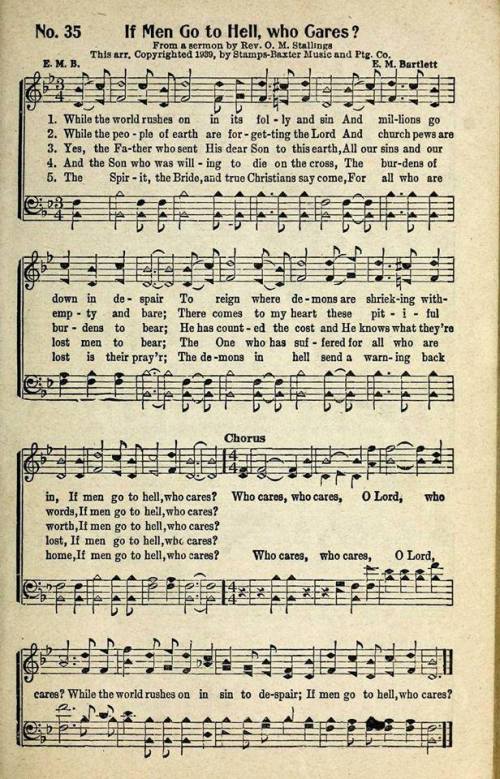
Let’s just say that the hymn in question probably was not a good candidate to be included in the hymnal. The final line of each verse as well as the refrain, and indeed the words used for the title of this hymn, are “If men go to Hell, who cares?”

No, it was not a strong candidate for a modern hymnal, though it was at least somewhat circulated in its own time. It appeared in two collections, including one associated with the family of eventual televangelist Rex Humbard, and was even recorded in the late 1920s by the Dunham Jazz and Jubilee Singers.

Even in its own framework, though, it’s not a very good song, for one very basic reason: it fails to offer the most basic answer to its title question. No matter how much apathy you might perceive in the church about the ultimate fate of all those men’s souls out there, it is ultimately theologically wrong to leave out that in fact God cares what happens to men’s souls. God cares! Jesus cares! The Holy Spirit cares! The whole Trinity cares what happens to men’s souls (and to women’s souls, too, which apparently didn’t concern even the author of this song…hmph). This omission ultimately leaves this old hymn as a distorted and incomplete portrayal of a God who claims each soul and a Jesus who gave up his life for that very purpose.

It’s the same kind of thing that would make “A mighty fortress is our God” one of the worst hymns ever if only the first stanza were ever sung. (It’s at #275 if you want to check.) Remember how that first stanza ends?

For still our ancient foe doth seek to work us woe.

His craft and power are great, and armed with cruel hate,

On earth is not his equal.

 It’s only when we keep singing and come to the second stanza’s reassurance that the “right man” is on our side, none other than Christ Jesus, that the first stanza makes any sense. No matter how dark the hymn might go, it does come back to the good news in a way that “If men go to Hell, who cares?” never does.

The pull between two seemingly different ends of singing that was noted in last week’s sermon – the desire and call to praise God and the mandate to instruct ourselves and one another – have very clear influences on the song that makes its way into worship and the song that doesn’t. While not every song manages to balance the two in perfect equilibrium, a good hymn doesn’t leave us in despair, and it doesn’t leave us stupider than we were before we sang it.

The second chapter of Paul’s letter to the Philippians is generally recognized as containing one of the most notable hymns to be found in the New Testament. While there are a few naysayers, most scholars agree that verses 6-11 do in fact constitute a hymn, one that was likely in use in the early church of Paul’s time. Whether it was a pre-existent hymn that Paul quoted, or one that was original to Paul and took root in the churches to which he ministered, is not a settled question. Still, it seems most likely that in these verses we are seeing a hymn of the New Testament church.

It is known as the “Christ hymn” for obvious reasons. While some scholars suggest Colossians 1:15-20 is also a “Christ hymn,” this one in Philippians is the most widely agreed example of such a hymn found in the epistles. It is clearly instructional; we are taught of Jesus and his coming into human form despite all the divinity that was his. Instead, not counting divinity as something to be “exploited” or grasped or clung to, Jesus “emptied himself” and took on humanity in full, humble and obedient even to “death on a cross.” From here the subject of the hymn changes; now we sing of God’s exaltation of Jesus “so that at the name of Jesus every knee should bend” in every corner of creation and that “every tongue should confess that Jesus Christ is Lord, to the glory of God the Father.” We are taught, and we are by the words of this hymn led to exalt Jesus, above every other name.

So in short, this is a pretty strong textbook example of a hymn doing the things we expect of a hymn that both teaches and exalts. It might be a little short on admonition, though. Don’t worry, though; our other scriptural song takes care of that.

At this point in the book of Deuteronomy, Moses has just about completed his work. The Hebrew people are ready to cross over into the promised land, but due to past transgressions Moses knows he cannot cross over; he has been making preparations to hand over the leadership of the people to Joshua for this purpose. The years are overwhelming him, and he knows his life is soon to come to an end. God has one more assignment for him, though.

In the verses we read God instructs Moses to write down a song and to teach it to the people. It is, to say the least, an unusual song. The last time we encountered Moses with a song was in Exodus 15, after the Hebrew people have successfully crossed the sea and been delivered from the pursuit of the Pharaoh’s army. That was a song of triumph and celebration, appropriate to the occasion, full of praise to the God who delivered them, as well as a bit of gloating over their fallen pursuers. This song is different, to say the least. While there are certainly words of praise to God to be found in the song, there’s lots of other stuff too.

The song that God commands Moses to write down and teach makes up most of Deuteronomy 32. It all sounds pretty good for the first fourteen verses or so, as the song sings all about the greatness of God and of God’s provision for the children of Israel. But as God describes in his instructions to Moses, things start to go off the rails at about verse 15. “Jacob” (a reference to the ancestor by that name who was renamed “Israel” by God) is charged with growing “fat, bloated, and gorged!” from overindulgence in the Lord’s provision, and ultimately with forgetting God and taking up foreign idols. The song then goes on to speak of God’s anger against the people for their infidelity, going so far as to call them “a nation void of sense” for their forgetting of the Lord who delivered them out of Egypt and into this land of promise. Eventually, however, the song does come back around to God’s restoring of the people’s well-being and to a concluding song of praise.

It is, at minimum, an unsettling song, with some pretty gruesome imagery and sharp language. It’s not a great candidate for being set to a familiar hymn tune to be sung in worship. But what could such a song possibly say to us about what we sing?

Well, remember that in last week’s scripture the letter to the Colossians speaks both of teaching and admonishing in those psalms, hymns, and spiritual songs. This is a bit extreme in that the admonition God is giving Moses to teach to the people is an “advance warning,” if you will; they have not even set foot in the Promised Land yet and already they are being warned about their future infidelity and faithlessness, and specifically in a song for the purpose of making sure they remember. As 31:21 puts it, “And when many terrible troubles come upon them, this song will confront them as a witness, because it will not be lost from the mouths of their descendents.” The whole point of the song is for the people of Israel to remember, all those generations later, that God knew their hearts all along.

Again, notice that the song, for all its seeming condemnation, does end on the high note of God’s faithfulness and of praise to God. The admonishment of whatever song we sing cannot forget that. No matter how bleak, we cannot forsake the most basic part of our faith, the unswerving persistence of God’s faithfulness.

After all of this scripture about our song and our singing, there is still one large point that needs to be drawn out. One of the great slip-ups modern Christians often commit in reading the Bible is all about getting the pronouns wrong, due to the particular ambiguity inherent in the second-person pronoun of the English language.

We are taught from a very early age that “you” can refer to one other person to whom you are speaking, or to a larger number of people to whom you are speaking. Despite the best efforts of southern culture to fix this deficit with the clever invention of the contraction “y’all,” this ambiguity continues to be something we always have to watch out for. Biblical Greek doesn’t have this problem; word forms change to indicate singular or plural audience.

Furthermore, with the exceptions of the letters to Timothy, Titus, and Philemon, the letters of the New Testament are not written to individuals. Each one is at minimum written to a local community of Christians, a group. Furthermore, the letters Paul wrote were frequently shared among the different churches Paul had started or led, meaning that multiple church communities might read any one letter.

Between these two points, we need to be reminded that any of this instruction we receive from these scriptures is not individualized. Paul, for example, isn’t writing to you; he’s writing to y’all. God doesn’t give Moses that song to proclaim to one individual, but to all of the Hebrew people. This singing and teaching and admonishing and praising and learning is for all of us. It’s y’all, or if you want to get all Texan about it, it’s to all y’all.

And even that has an effect on what we sing. We don’t know for sure if the Christ hymn in Philippians was written or quoted by Paul, but he clearly meant for his readers – not just in Philippi, but wherever the letter went – to know it and to take it to heart. That hymn was to go to all the churches if it wasn’t already in all of them.

So it is with the songs we sing. It doesn’t do to cut ourselves off from the church in Ocala or Tampa or Tallahassee with our own little set of favorites that we sing over and over and over and over again. It doesn’t do to cut ourselves off from the church in New York or South Bend or Petaluma either. For that matter it doesn’t do to set ourselves off from the church in Mexico City or Kyoto or New Delhi or Johannesburg either. If we are truly one church, we sing together. We share the song of the church with one another, no matter how far-flung or different it may seem sometimes. We teach and admonish one another, and are taught and admonished by one another, not just here in this sanctuary, but in the whole church, wherever it is planted. That’s uncomfortable at times, but truly necessary if our song is to do the work God gave it to do.

We sing songs that praise God. We sing songs that teach us and remind us of who God is, who Jesus is, what the Holy Spirit does. We sing songs that bind us together. We sing songs, sometimes, that call us out, but never without reminding us and returning us to the goodness of the God we love and serve. That’s a lot of work for song to do.

For the song we sing, Thanks be to God. Amen.


Hymns (from Glory to God: The Presbyterian Hymnal): 821, My Life Flows On (How can I keep from singing?); 800, Sometimes a Light Surprises; 215, What Wondrous Love Is This; 363, Rejoice, the Lord Is King!


If men go to hell


Sermon: Why We Sing

Grace Presbyterian Church

September 15, 2019, Pentecost 14C

Colossians 3:12-17

Why We Sing

I am compelled to confess, before this sermon even gets started, that the title given to it is not completely honest. This is so because the reasons we sing as a part of our worship are far too numerous and prolific to be covered in one sermon that hopes to land somewhere between ten and fifteen minutes. There are probably too many to be covered fully even in a much longer sermon, but the point is that this will not be exhaustive; you may well think of plenty of other reasons we sing in church that I don’t mention, and that’s perfectly fine.

What this particular reading from the letter to the Colossians prompts us to do, though, is to consider some of the reasons we sing in worship that we don’t necessarily think about consistently. The instruction here takes the role of song in the Christian gathering in directions that may not regularly cross our minds these days, accustomed as we are to song and music largely treated in our society as entertainment, something done solely for pleasure. There is plenty of pleasure to be found in the act of singing, to be sure, but that’s not necessarily all that there is to it.

This instruction about singing, for example, comes in a larger context that concerns what, exactly, it looks like (or should look like) to live in Christ. Apparently the Colossians had gotten caught up in more legalistic or rule-bound ideas of what it meant to live as a Christian, as described in Chapter 2’s admonitions against being caught up in “philosophy and empty deceit, according to human tradition” (2:8); being condemned “in matters of food and drink or of observing festivals, new moons, or Sabbaths” (2:16); or being bound to “submit to regulations, ‘do not handle, do not taste, do not touch’” (2:20-21). As the author says of such rule-bound living,

All these regulations refer to things that perish with use; they are simply human commands and teachings. These have indeed an appearance of wisdom in promoting self-imposed piety, humility, and severe treatment of the body, but they are of no value in checking self-indulgence. (2:22-23)

The Colossians are being urged not merely to submit to a new set of rules, but to live a new life in Christ. Chapter 3 takes up the task of describing what such a life looks like, beginning with the admonition to “set your minds on things that are above” (3:2). There are emphatically things that simply cannot be part of such a life, and the chapter continues with such traits as cannot be compatible with life in Christ – traits such as greed (which is called out as idolatry), lying, malice, and many others.

Then comes the good stuff – literally, the things that are good to do as part of living in Christ, or more directly that good things that happen when one is living in Christ. First come characteristics such as compassion, kindness, humility and such. The pinnacle seems to be in verse 14: “Above all, clothes yourselves in love, which binds everything together in perfect harmony. “ Following upon this is the instruction to “let the peace of Christ rule in your hearts” and “to be thankful.” Then (and only then) comes the instruction about singing that catches our attention today. In other words, all of this forms the context for the instruction that is to come. Therefore this instruction needs to be understood as not merely an extra or frill, but as a major part of the life we live in Christ.

The instruction of 3:16, unfortunately, is one of the most easily mangled verses in all of the Greek New Testament literature. Sorting out what the participles do and how they are directed, or determining which clause is connected to which clause and how they relate to one another, is quite enough to send even the most committed and determined grammarian over the cliffs of despair. Sadly, I have to conclude that the NRSV in our hands and pews today missed the mark, to some degree, and that of all things, the good old-fashioned King James Version comes closer to the intended sense of this verse:

Let the word of Christ dwell in you richly in all wisdom; teaching and admonishing one another in psalms and hymns and spiritual songs, singing with grace in your hearts to the Lord.

(Nine out of ten times the NRSV is going to come closer to the sense and meaning of the Greek, but this is time number ten.)

So this really is saying that singing is a significant part of living in Christ, and more precisely living together in Christ. But this isn’t just any old instruction to sing. The singing is instead directed, fulfilling two different purposes at the same time.

First, the singing is directed to us as instruction. When we sing we really are being taught to do so as a part of “teaching and admonishing one another in all wisdom.” It’s not a stretch to argue that in the era in which this was written, one in which not everybody could read, “teaching and admonishing” through song had a highly practical aspect to it – as we’ve noted in a previous sermon on music in the church, we’re a lot more likely to remember what we have sung than what somebody has preached at us.

This practical component of singing as instruction continued in the church for quite some time, as long as literacy was not a commonplace phenomenon among the people. A major church figure like Ambrose of Milan, the fourth-century bishop and teacher of Augustine, found the creation of hymns an effective means of teaching doctrine and even of combating heresy. (Indeed, even at a time when hymns were not sung by the congregation in worship they were still being created for people to learn to sing.)

[NOTE: Two of Ambrose’s hymns are in our hymnal even today: #102, “Savior of the nations, come,” an Advent hymn originally translated into German by no less than Martin Luther, and #666, “O splendor of God’s glory bright,” a morning hymn in which the image of Christ as “light of the world” is played out among various images of light.]

Perhaps we don’t take this aspect of our church’s song quite so seriously today. We’ve already noted that we are culturally conditioned to think of song as primarily for pleasure. No matter what style or genre of music is our favorite, first of all we tend to listen to it rather than sing it, and alsw we tend to listen to it primarily as a commodity, whether we bought it as a CD or download or purchased a ticket to hear it live.

And if we are honest with ourselves, we often bring a similar attitude to the music we sing or hear in church. We’re often concerned mostly with the fact that the song was “so beautiful,” or that it was a “favorite” from years gone by (which is really another form of listening for pleasure, isn’t it?). But this instruction to the Colossians challenges the notion of the song we sing being only for pleasure. It quite insists that the songs we sing do more than give pleasure; they give instruction, they give learning both of the positive and negative kind (both teaching and admonishing, remember). Given what we now understand about the psychology of song and singing, we can say that the songs we sing do instruct us, period. We can then ask ourselves whether those songs teach and admonish us for good, or otherwise.

Another factor is that if our songs really do teach us, it does require us to listen to what we sing. It doesn’t do to sing mindlessly. This is a fearfully challenging thing; it pushes us to realize that if something we are singing is no longer instructing us, is no longer something we actually hear when we sing it, we may need to reconsider it.

There is one more clause in that verse that we do need to address; the verse wraps up with the instruction about “singing with grace in your hearts to God.” The business about teaching and admonishing does not rule out or supersede the act of singing to God; rather, the two go together. We teach and admonish one another in psalms, hymns, and spiritual songs, and we sing to God with grace in our hearts. To do one is to do the other.

For example, we might look to the hymn we will sing after this sermon. The very first words are pretty direct about who is being addressed here: “Lord Jesus, you shall be my song as I journey” (as translated from French in this case). It’s pretty clear we are singing and addressing Christ in this hymn, and Jesus’s name does return in the second and third verses as well, enough to keep Jesus in focus as the one to whom we sing. At the same time, though, we are being taught about how to live in Christ; “I’ll tell everybody about you wherever I go; you alone are our life and our peace and our love.” You could find more throughout the hymn, but maybe the fourth stanza is worth emphasizing: “I fear in the dark and the doubt of my journey, but courage will come with the sound of your steps by my side.” What a wonderful thing to remember as we sing. We are singing to Jesus, and we are teaching one another as we sing, doing so “with grace in our hearts.”

There is one more part of the verse we haven’t addressed specifically yet. The church at Colossae is being instructed to teach and admonish one another with “psalms and hymns and spiritual songs.” To some degree these terms can be said to have particular meanings. “Psalms” seems an obvious enough reference to that collection of songs found in Hebrew scripture, from which our responsive readings usually come. “Hymns,” on the other hand, seems to refer to the songs not necessarily found in scripture, but which (for example) make up the bulk of our hymnal, what used to be called ‘hymns of human composure’ (as if David and Asaph were somehow not human when they wrote all those psalms).

It’s harder to discern “spiritual songs” as a separate and distinct category from the other two. Nonetheless, what does seem clear from this instruction is that songs of many differing kinds are to make up the repertoire by which we teach one another and sing to God. Next week’s sermon will have more to say about this, but at minimum we might need to consider that when we get trapped or caught up in singing only one particular style or type of song as part of our worship, it might be a danger sign: our singing might be less about singing to God and instructing one another than about, well, something else.

In conclusion, I might need to take back something I said towards the beginning of this sermon. I demurred on the accuracy of the title of this sermon, claiming I could not hope to speak to all of the reasons we are to sing in one short sermon. That might not be completely accurate; maybe, in fact, all of the other good reasons one might argue for singing in worship actually do fall under one of these two reasons for singing in worship – reasons which as we’ve already seen actually go together anyway. A song that takes the form of lament; does it not also sing to God, and does it not also teach us about grief and suffering? A song of testimony certainly can be directed towards God and instruct us on living in Christ.

Even so, there’s still a lot more that could be said. Hopefully this does make the point that is needed here; we sing to God, and we sing to instruct one another, and this is good, and this is what God wants us to look like, as part of life in Christ.

For song to God that teaches us as well, Thanks be to God. Amen.


Hymns (from Glory to God: The Presbyterian Hymnal): #267, Come, Christians, Join to Sing; #17, Sing Praise to God, You Heavens! (Psalm 148); #737, Lord Jesus, You Shall Be My Song; #804, Rejoice, Ye Pure in Heart!


Note: I am much indebted to David Detwiler, “Church Music and Colossians 3:16,” in Biblioteca Sacra 158 (July-September 2001), 347-69, for guidance in formulating how to express the ideals that are found in this passage. 

Second note: The featured image is the alternate cover of The Presbyterian Hymnal (1990) created for sale to churches or organizations that are not Presbyterian. The current hymnal, Glory to God: The Presbyterian Hymnal, is also available with a similar alternate title, Glory to God: Hymns, Psalms, and Spiritual Songs. 


1 Comment

Sermon: Make Themselves Heard

Grace Presbyterian Church

September 8, 2019, Pentecost 13C

2 Chronicles 5:11-14

Make Themselves Heard

The book of 2 Chronicles (or its partner book 1 Chronicles for that matter) doesn’t show up in Sunday morning services that often. This book only appears once in the Revised Common lectionary, for example (and it’s not this passage), and 1 Chronicles doesn’t show up at all. Even if one were inclined to recount one of the stories included in either of these books, one would be more likely to find and use that story from the books 1 and 2 Samuel or 1 and 2 Kings, since the Chronicles books are in essence recapitulations of the accounts found in those books. For example, the event of which today’s reading is a part, the dedication of Solomon’s Temple, is also recounted in 1 Kings 8. One might almost wonder why the two books were preserved in canon at all.

However, the Chronicler (that’s the clever name that biblical scholarship has given to the unknown author of these two books) sees these events with a different eye, from a different historical perspective. Among other things, the Chronicler seems to have a fondness for the ritual and ceremony that surrounds major events in Israel’s history, a fondness which provokes him (or her, you never know) to include details and touches that escaped the eye of the authors of Samuel and/or Kings. It is this eye that provokes the inclusion of this short passage that constitutes today’s reading, one not found in the 1 Kings parallel reading. It’s a passage that carries a lot of weight (or should) for anyone who cares about the practice of music in the worship and ritual of the church.

A little context: as noted before, this episode takes place during the dedication of what is most commonly known as Solomon’s Temple. Indeed it was built under Solomon’s reign, and that king himself offered the dedicatory prayers that constitute most of the reading that follows this excerpt. This is the Temple that would go to ruin when the eventually split kingdoms of Judah and Israel were conquered and led into exile; it was the Temple that was rebuilt after the return from exile that would be prominent in the stories we find in the New Testament.

But this is Solomon’s Temple, the one that King David had so longed to build only to be put off by God, who declared that it would not David but David’s son who would build it. The first chapters of this book (also the earlier chapters of 1 Kings) are taken up with the preparations for building the Temple, including description of the furnishings that would be placed in the Temple; finally in chapter 5 we get to the dedication of the Temple. The chapter begins with an account of what must have been a moving moment for the people of Israel: the placememt of the Ark of the Covenant itself, the very vessel that had contained the tablets of the Ten Commandments, the source of the Law itself. At long last, after its many years of wandering with the Israelites and being kept in a tent, the Ark was taking its place in what was meant to be the holiest site in Israel, as King David had envisioned.

The 1 Kings account details this event, in which all the priests and Levites and elders of Israel were all gathered to bring the Ark into the Temple, and it even includes the fascinating scene in which a cloud, representing the glory of the Lord filling the holy place, billows up and fills the Temple, an obvious echo of what happened when Moses first erected the Tabernacle for the Ark as directed by God in Exodus 40. But the Kings account leaves out something that the Chronicler doesn’t miss, and that is what happened right before that cloud billowed up.

The Kings author left out the music. The Chronicler didn’t.

At this point the Chronicler veers from the Kings account to record what he (or she) saw as a vital portion of the dedication ritual. After the Ark had been placed and all those who had borne it withdrew from it, another assemblage did its work. In this case an assembly of what the Chronicler calls “liturgical singers” took their position to the east of the altar and sang, with the accompaniment of one hundred and twenty trumpeters, along with cymbals, harps, and lyres. Personally I can’t imagine trying to sing and be heard over one hundred and twenty trumpeters, but at least this was apparently outside instead of in a confined space.

It was the duty of these singers and trumpeters, as the Chronicler notes, to “make themselves heard.” No sweat for the trumpeters, but that sounds like a mighty large job for the singers. Nonetheless they were charged with the task of making themselves heard in singing  a particular hymn of praise and thanksgiving to God, part of which is recorded in verse 13:

For he is good,

For his steadfast love endures forever.

It’s a pretty simple refrain, and one that is heard more than once in scripture, including earlier in this book. It also appears with frequency in the Psalms; you might remember it from last week’s responsive reading from Psalm 118, in which “his steadfast love endures forever” briefly becomes a repeating refrain. This phrase actually happens forty-one times in Hebrew scripture, including as a repeated refrain in Psalm 136. It occurs earlier in 1 Chronicles as this same sung refrain at the dedication of different holy sites built while in waiting for the Temple; it comes up again in the book of Ezra, as the foundation is laid for the rebuilding of the Temple after the return from exile; it even pops up in the book of the gloomy prophet Jeremiah.

God’s “steadfast love” also shows up in that Song of Moses that was last week’s reading from Exodus, and even makes an appearance in the text of the Ten Commandments from Exodus 20. In other words, the choir is singing something that has been known as a key signature of God’s relationship with the Hebrew people from the earliest parts of their history.

The choir sings, the trumpeters play, presumably the players of the harps, cymbals, and lyres also play…and in the Chronicler’s telling this is when “the house, the house of the Lord, was filled with a cloud” meaning nothing less than that “the glory of the Lord filled the house of God,” so profusely that the priests had to back off from their priestly duties for a bit.

Choirs get a bad reputation sometimes. The history of music in the Christian church records a few occasions in which the choir was perhaps a little disruptive or detached from their duties in the service of worship. One of the funniest things I ever had to read during my music history studies all those years ago was of an incident recorded at the cathedral of Cambrai, in France, some time during the fifteenth century, I believe. One of the priests recorded a complaint about the choir (which might have included boy sopranos as well as men at the time) being particularly disruptive during one service to the point of throwing chicken bones back and forth at one another across the divided choir chancel of the cathedral, presumably while the bishop was giving his homily. Certainly that’s an extreme instance of bad behavior, but there is always the danger when any person or group of people is set apart for a particular activity in worship. You don’t think that preachers have succumbed to pride and vanity across the church’s history? Sure they have. Preachers can succumb to it, choirs can succumb to it, organists can succumb to it. Heck, ushers can succumb to it.

But that danger doesn’t stop preachers from being called to preach, and it doesn’t mean that choirs should not be formed and prepared to sing forth God’s praises as part of worship. Despite the tired arguments of a few heavily pedantic types over the centuries, and even the fearful banishments of choral song in worship even by otherwise intelligent figures such as John Calvin himself, the song of the choir can and does perform a good and worthy function in Christian worship.

Another point to ponder: we read, a few weeks ago in the prophet Isaiah, a stinging denunciation of the worship and rituals of Isaiah’s audience, a close parallel of the more famous passage in Amos 5:21 in which God says through the prophet that “I hate, I despise your festivals, and take no delight in your solemn assemblies.” This displeasure, you’ll remember, had to do with the failure of the church to live up to its call to care for the poor, the oppressed, the “widow and orphan,” and all those disfavored by the world but favored by God. It does remain true that no Christmas Lessons and Carols service or Easter cantata can make up for the failure of the church to live in obedience to God’s call upon it, which may come as a shock to churches out there that pour untold resources into their music programs while ignoring the world around them. But, when the church is “living right,” so to speak, the music of the church – including the music of the choir – can be and is pleasing to God.

Notice that this scene from the Chronicler takes place very early in Solomon’s reign. The kingdom of Israel is still united. This is still the Solomon who, when given the opportunity to choose what God might bestow upon him, asked for wisdom to lead his people. This Solomon hasn’t yet gone off the rails of obscene riches and extravagant living and seven hundred wives tempting him to go after false idols.

In short, Israel and its king are still living at least somewhat close to God’s instruction to them, in a way that is pleasing to God. In that context, the musical offering of this large choir and orchestra of trumpets, singing of God’s “steadfast love,” was also pleasing to God. Likewise, when the church remains faithful to God’s call to serve and to love, holding fast to God’s mission for us in the world as demonstrated in the life of Jesus and the prompting of the Holy Spirit, our worship, including our musical worship, is also pleasing to God. God may not fill up the church with a cloud of the glory of the Lord every time the choir sings, but God can be pleased with the musical offering so given.

One last caveat: the music of the choir is never a substitute for the song of the church as a whole. You will eventually notice that the hymns and songs of the congregation will actually get two Sundays worth of attention compared to this one Sunday given to the choir and its role in worship. In fact, one of the most valuable roles of any choir is to lend support and even a little education to the singing of the congregation, which you’ll see this choir do on occasion by introducing a hymn or song we’ve not sung before in a way that helps teach it to everybody. In that sense the choir truly takes the role of leading in worship as surely as any preacher or liturgist does.

Now the public service announcement: the choir began its rehearsal schedule this morning, meeting at 9:45 to prepare music for worship for today and for Sundays to come. It’s open to all. It doesn’t even require a separate night of the week for you to get out and come. And as the Chronicler reminds you, it is (when we’re doing church right) pleasing to God.

So, for the song of the choir, Thanks be to God. Amen.


Hymns (from Glory to God: The Presbyterian Hymnal unless otherwise noted): #689, When the Morning Stars Together; #550, Give Praise to the Lord (Psalm 149); #—, The Priestly Choir Came Forward; #385, All People That on Earth Do Dwell


Sermon: When They Had Sung the Hymn

Grace Presbyterian Church

September 1, 2019, Pentecost 12C

Psalm 118:1-9Exodus 15:1-8; Mark 14:22-26

When They Had Sung the Hymn

Obviously I am no longer part of the church or church tradition in which I grew up, but I should acknowledge that it did do some good things for me. It taught me to know my way around the Bible and encouraged me to sing early and often, among other things. But boy, it left me with some confusion for sure. For example, for years I was convinced that the song Jesus and the disciples sang at the end of the Last Supper was “Blest be the tie that binds.” Seriously, once the Lord’s Supper had been completed, the pastor always offered up the rough quote “and the scripture says that they sang a song and went out,” and then we would sing “Blest be the tie that binds.” Always. I promise you the first time I went to a church that sang something other than “Blest be the tie that binds” at the end of communion, I was as confused as I had ever been to that point in my life. If we had observed the Lord’s Supper more than four times a year I might never have unlearned that.

Of course I did eventually figure out that since that hymn wasn’t written until 1782, it couldn’t possibly have been sung at the Last Supper. In fact, most likely anyway, what they sang was some portion (or maybe all) of what came to be known as the Hallel, or in some cases called the Egyptian Hallel. The Hallel consists of Psalms 113-118, and had come, from a very early time in the observance of Passover, to be a significant part of the ritual. You might notice if you go back and look that the two hymns we’ve sung so far in the service nod towards that practice; the first one being an extremely amplified and expanded paraphrase of Psalm 117, and the second a paraphrase of Psalm 116. While it’s not certain, some suggest 113-114 were sung before the meal and 115-118 after.

That would make Psalm 118, a portion of which was our Responsive Reading, the last thing they sang before going out. Think about that. Jesus knows darned well what he’s headed into. He knows what Judas has been up to. And going into the darkest night, the night to come of corrupt trial and deep rejection and physical abuse and scorn, ultimately to culminate in crucifixion, this song is ringing in his ears: his steadfast love endures forever…with the Lord on my side I do not fear. What can mortals do to me?…the Lord is my strength and my might; he has become my salvation…I shall not die, but I shall live, and recount the deeds of the Lord…the stone that the builders rejected has become the chief cornerstone…O give thanks to the Lord, for he is good, for his steadfast love endures forever.

Many of the times that song is recorded in scripture the song is all about triumph. Psalm 118 has that quality; the “song of Moses” after the crossing of the sea and escape from Egypt in Exodus is another. But here is not a scene that seems all that triumphant. Of course, we know how the story turns out; triumph does come on the third day. It’s hard not to wonder if any of the disciples caught on to this when that third day came. Did any of them remember the song, either on that dark bleak night or on that third day?

There is something about song and singing that cuts through the darkest of fogs of memory. It is a well-known phenomenon now, the way that a person long lost to dementia or Alzheimer’s or some similar condition can awaken to vibrant life at the catch of a familiar song. Of course, preachers have known for a very long time that things sung stay in the memory a lot longer than things heard. Why do you think we sing four hymns in the service? With any luck, one of those hymns will stay in your mind far more and far longer than anything I say in this pulpit or from this table.

Song is a gift. It keeps popping up throughout scripture, not even so much in the form of instructing to sing or forbidding to sing, but simply in singing. Those experiencing triumph sing a song of praise; those in trouble sing a song of lament. It’s there, and it keeps on sounding in the church despite the worst efforts of some in the church’s history to stifle it or constrict it or rob it of its power. Song is a gift, and absolutely a gift of God to the people of God, and we need to cherish it and hold on to it and not rob ourselves of the comfort and strength it gives.

When they had sung the hymn, they went out. They went out into a night that was darker spiritually than it was physically. When we sing the hymns today, we go out into broad daylight, but indeed there is a storm on the horizon. God gave the gift of song for both the nights of darkness and the brightest of days. How dare we not live out that gift, no matter what we face?

For the song to sing; Thanks be to God. Amen.


Hymns (from Glory to God: The Presbyterian Hymnal): #327, From All That Dwell Below the Skies; #655, What Shall I Render to the Lord; #641, When in Our Music God Is Glorified; #611, Joyful, Joyful, We Adore Thee


Sermon: Sabbath, Healing, and Not Healing

Grace Presbyterian Church

August 25, 2019, Pentecost 11C

Isaiah 58:9b-14; Luke 13:10-17

Sabbath, Healing, and Not Healing

To some degree we get a break this week, or so it seems, from the seemingly relentless demands for justice and righteousness and care for the poor and oppressed that has been characteristic of the readings from Luke and Isaiah that have been read these last several weeks. Of course, that isn’t really true; Isaiah is still sounding the clarion call, and the story related in Luke is actually an account of Jesus putting into practice what he has preached, in the face of a hyper-legalistic opposition that insists that rules about Sabbath must somehow overrule God’s call to do justice and to liberate those bound, in this case by her own body.

The story starts innocently enough. Jesus is teaching in a synagogue somewhere, on an otherwise unidentified Sabbath. The woman in question, who we will learn had been crippled for eighteen years by this condition that kept her “bent double,” appeared – it isn’t clear whether she showed up late, which might be understandable, or she simply first came into Jesus’s sight at this point. Whatever it was, note that the woman herself did not do anything to call attention to herself; this isn’t a case (as were many recorded in the gospels) of someone approaching Jesus begging to be healed. As far as we are told, she simply showed up at the synagogue, presumably expecting to listen to the teaching of, as far as she knew, whoever was teaching that day. She took her place, presumably at the back of the room, as women were supposed to do according to the rules of the synagogue – men in front, women in back – and listened. Indeed, there’s no indication she had any idea Jesus was the one teaching or knew about Jesus at all.

No, in this story the initiative is fully and intentionally Jesus’s. Jesus calls her over; Jesus speaks to her telling her she is “set free from your ailment”; he lays hands on her. At that she is able to stand up fully, and does so with rejoicing. One might imagine the crowd in the synagogue also rejoicing at the sight.

What happens is possibly a little like the scene after your team scores a touchdown, only to see that some highly zealous official has thrown a penalty flag on the play. In this case, an official of the synagogue throws cold water on the proceedings with the charge that curing on the Sabbath violated the rules of the Sabbath as handed down in the Torah and in its interpretation (possibly an illegal procedure penalty, to extend the metaphor). You’ll note that today’s reading from Isaiah also placed a premium on how the Sabbath was to be kept, mandating that God’s people “refrain from trampling” the day and not pursue their own interests instead of God’s.

Like any good coach in the face of a bad call, Jesus argues back – but in this case Jesus has the rules, the interpretation of Sabbath law from Torah in this case, on his side, and indeed the official has blown the call. His answer might sound a bit obscure to us, but it makes perfect sense in the culture of the time and place. As interpreted by scribes and scholars over the centuries, the seemingly strict law about observing the Sabbath – going back to that commandment, number four of ten, which instructed to “Remember the Sabbath day, and keep it holy” (Exodus 20:8), followed by possibly the most detailed interpretation of any of the Big Ten as to what exactly it means to do that – do your work for six days, but not on the seventh, neither you nor anyone in your family nor the alien who lives among you, nor your beasts of burden.

If you know anything about working animals, though, even if they aren’t being used for work on a given day, they still need to be fed and watered. Particularly in a hot and dry climate, oxen or donkeys would very definitely need to be given water or else, at the very minimum, they would not be much good for work the next day, and maybe much worse.

So the ongoing and extensive tradition of interpreting the Law included what amounts to an exception for the sake of compassion; the “work” of leading a work animal away to be given water, and then presumably leading that animal back to its lodging, was not forbidden on the Sabbath. Besides being good for the working of the fields, it was a basic interpretation of compassion for those beasts who were, after all, fully a part of God’s creation, for which humanity was charged to be good stewards and caretakers. So you might say that the command (direct from God) about the Sabbath was being interpreted in light of the even older mandate (also direct from God, in Genesis) to care for creation.

With this compassionate exception to Sabbath law in hand, Jesus then confronts the official with a call for more compassion. If we can show such compassion to an ox or a donkey on the Sabbath, Jesus asks, how can we withhold such compassion to this woman, a “daughter of Abraham” as Jesus names her, as to leave her bound to her deforming condition because it’s the wrong day of the week?

You don’t always see Jesus’s opponents in these disagreements described as being “put to shame,” but that’s how Luke describes the response to Jesus’s defense of his healing. They are silenced, apparently, and the crowd does engaged in full-throated rejoicing – not just at this one healing, Luke says, but at “all of the wonderful things that he (Jesus) was doing.” Apparently his reputation had at least kept up with him after all, and this story really does have a full-fledged happy ending.

Now there are a couple of things to note about this particular story. The woman had been in this condition for eighteen years. What this suggests is that while this condition was no doubt painful, and made the woman’s life extremely difficult and challenging, it was not a life-threatening condition. The act of healing that Jesus performs here was not what we might think of as an “emergency” healing, like so many of the healings attributed to Jesus in the gospels. Healings of those who are very ill, on the verge of death, or even believed to have died seem more common across the gospels than a healing of this nature.

This offers us a clue to a fuller understanding of Jesus’s acts of healing. Restoration of life, it turns out, can have more than one meaning. Surely the healing of one on the verge of death is a “restoration of life,” but here also is a “restoration of life” even in the woman in the synagogue was not on the verge of death. To be so severely bent over as to be unable to look others in the eye was indeed a life-diminishing condition, even if not a life-threatening one.

And this is important enough for Jesus to single out and heal this woman, Sabbath or not. Being healed by Jesus is about being healed “all over,” so to speak; healed from that which threatens life, to be sure, but also healed from that which impinges or hinders life. A woman who couldn’t look her neighbors in the eye could stand up tall and walk proudly among her neighbors, and apparently to Jesus, that matters, even enough to tick off a synagogue official on the Sabbath.

As with bodies, so with souls. Healing is about more than the preservation of life. As Jesus says in John 10:10, “I came that they may have life, and have it abundantly.” Just barely living isn’t the point; living fully, living abundantly, “living out loud” (to use a modern turn of phrase); this is the desired outcome of Jesus’s acting in our lives. To the degree that we don’t do that, we shortchange what God through the Spirit is moving in our lives to do.

But there’s a flip side to this, and I freely admit it is one I might not have appreciated it in this passage had I come to it before what happened to me three months ago.

How many others in that synagogue that day were suffering their own afflictions, their own life-impinging conditions that weren’t necessarily seen before the world?

How many others, in how many other settings across the gospels, did not receive healing?

Let’s get personal; how many do we know who did not receive healing?

It can be hard – painfully hard – to read such stories in the gospels when one suffers one’s own need for healing. You cry out, you pray, you beg and plead and make promises and make vows and everything you can think of, and yet your illness doesn’t go away, your condition doesn’t improve; or your loved one dies anyway.

I’m going to guess that most of us here today have had some variation of that experience, whether we or a loved one was in need of healing that somehow didn’t happen.

Why? Why???

Clearly I can’t give you an answer. Even if my own health were perfect I wouldn’t be able to give you an answer.

Only just yesterday I heard about an old friend, from back in high school days, who has suffered cancer and been undergoing treatment. Some of you know just how difficult and challenging and painful that can be, from firsthand experience. Why? Why???

Yeah, it can be really hard to read one of these healing miracle stories now. Harder, frankly, than I expected.

And yet, we are still called children of God. We are still called the body of Christ, even with all the brokenness and illness in our own bodies. What kind of body Christ must have now, made up of us broken and hurting bodies and souls? And yet this is who we are.

I wish I had some easy answer. I don’t. I only have Jesus, the moving of the Holy Spirit in us, picking us up and carrying us along sometimes when all else seems to have broken down and quit. Maybe in the end, that really is enough to live.

Thanks be to God. Amen.


Hymns (from Glory to God: The Presbyterian Hymnal unless otherwise indicated): #393, O Day of Rest and Gladness; #620, Praise, My Soul, the King of Heaven; #—, With Our Earthly Bodies Broken; #797, We Cannot Measure How You Heal

bent woman


Sermon: Sour Grapes

Grace Presbyterian Church

August 18, 2019, Pentecost 10C

Isaiah 5:1-7

Sour Grapes

While we mostly think of “song” in Hebrew scripture as principally contained in the book of Psalms, there are other examples scattered throughout the literature that can also be identified as song-like, or which identify themselves as song in some way. For example, the book of Exodus contains passages described as “song” surrounding the event of the Exodus itself, such as Miriam’s triumphal song after the defeat of the Egyptian army.

While the prophetic literature is not necessarily thought of as being terribly poetic or songlike, there are still occasional examples to be found here as well, such as the passage that constitutes today’s reading from Isaiah. It self-identifies as song, as the author begins with the rather obvious clue “Let me sing…” and continues from there. It turns out not to be much of a song, though, as it gets interrupted very quickly (by the very subject of the song, no less), and ends up turning rather bleak and dark before finally being revealed as much more an extended metaphor than a real song.

The song, such as it is, sings of one who plants a vineyard on what is described as a “very fertile hill.” The work this planter did is laid out in meticulous detail; the land is dug out and cleared of any stones that might interfere with the nurture and growth of the vines. A watchtower is erected, in order to keep watch and guard against any who might seek to bring harm to the vines in the vineyard or to poach its fruit. A wine vat is installed, so that there is as little time or space between vine and wine as possible. In other words, the planter and tender of this vineyard has done everything right, everything possible to ensure the best possible results for this vineyard.

Nonetheless, in the end the vineyard produced “wild grapes.”

Here is a case in which our ability to translate the Hebrew idiom being used is a bit lacking. “Wild” grapes is a technically correct term, but doesn’t even begin to capture all of the negative connotations of the fruit of this vineyard. Personally I’m a fan of “sour” grapes in this case, if mostly because the modern slang idiom it represents isn’t a bad representation of the result by the time this song is done, but even that term – pungent as it is – doesn’t fully capture the impact of just how bad these grapes are. They’re not just “sour.” They don’t just taste bad, they smell bad too, even still on the vine. One could almost say these are “rotten” grapes. They are utterly offensive, fit for consumption neither for human nor beast.  Heck, maybe they’re even poisonous. They sure taste poisonous.

It is at this point, once the “sour” grapes have been revealed, that the voice of this passage shifts and the original singer is usurped by the planter who was ostensibly the subject of the song. You can tell by the way the pronouns shift to first person: “judge between me and my vineyard.” The language, far from poetic now, has turned prosecutorial, an echo of the language from last week’s reading from the first chapter of this book. While it’s a little bit odd to be asked to pass judgment on a vineyard, our questioner is not much concerned with such niceties. “What more was there to do…?” he asks. “Why … did it yield wild grapes?” You can imagine the questions, possibly from different parts of your own life. Where did I go wrong? What didn’t I do? Whether it’s over a child who seems to have gone off the path or a career that turns south, it’s not unheard of for us to find ourselves asking questions like “what more could I have done?”

This situation is a little different, though, as it turns out, and the narrative takes a darker turn at this point, as our vintner announces his plan for dealing with the sour grapes that have infested his vineyard. It comes as a bit of a shock, does it not, to hear how he plans to – in effect – engage in passive destruction of the vineyard? “I will remove its hedge, and it shall be devoured; I will break down its wall, and it shall be trampled down. … it will not be pruned or hoed, and it shall be overgrown with briers and thorns…” And then the final clue about the planter: “I will also command the clouds that they rain no rain upon it.” That gives the game away, doesn’t it? Commanding the clouds not to rain is rather beyond the capacity of most any planter of most any vineyard or orchard or farm or whatever you might imagine.

No, this is no ordinary vintner and vineyard. Isaiah jolts his readers that the vineyard is nothing other than the nations of Israel and Judah, the divided remnants of the Israel that had first been planted in that land by the Lord centuries before. Suddenly that talk of removing the hedge and breaking down the wall and being overgrown with briers and thorns becomes all the more ominous as Israel and Judah see themselves in that spot. It’s another opportunity for Isaiah’s readers and hearers to respond as last week’s oracle might have prompted them to do: “oh, no…we’re in trouble.”

And yet again, the sins of the people come back to the theme of injustice. The vineyard was planted, as it turns out, to bear justice and righteousness as its fruits. But instead of justice, the Lord saw his “pleasant planting” produce bloodshed, violence against his own people. No righteousness, but instead the cries of those persecuted, punished, suffering. Rotten grapes, indeed.

Now what we are to make of this particular song requires some qualification and clarification. We modern Christians are clearly not the “house of Israel” or the “people of Judah.” We just aren’t. We are not in a position to apply the lesson of this song-cut-short in any kind of direct way to our own individual selves, nor for that matter to our country – the United States is not Israel or Judah by any means.

On the other hand, we do share one thing in common with the “house of Judah” or the “people of Israel”; we do claim (or are claimed) to be the children of God. And that does put a burden of responsibility squarely on us.

And notice that it is “us” here. This is not a prophetic oracle directed at any one individual. No king or priest gets singled out here. The “house of Israel” and the “people of Judah” are the only addressees of this message. The responsibility for the bloodshed and the “cry” of the oppressed is corporate: all of the people bear responsibility together.

In this we do share in the message given. Not even as a country, necessarily, but as the “church” in the broadest sense of the world, we are held responsible. And it is we as the broader, corporate body of the children of God, who face the frightening removal of protection that the vintner plans for the vineyard.

God is faithful to the believer. Whether it is framed in the language of “once saved, always saved” popular in certain circles of the church or in some other framework, God does not abandon any child of God. Period. End of discussion.

Human institutions, on the other hand (no matter how much their origins may be divine), have and can expect no such guarantee. Even a cursory reading of Hebrew scripture makes it clear that Israel and Judah were not remotely spared the ignominy of conquest and exile despite the whole extensive history of God’s call and exodus from Egypt and “promised land” and all of the seemingly “special” status that came with it. Once it came down to the two kingdoms straying from the call to justice and righteousness that had been their birthright, the hedge was indeed lifted and the wall broken down. The kingdoms were conquered and subjugated.

Likewise with any human-structured institution that strays from God’s mandate: if we fail to live up to God’s instruction to practice justice, to defend the oppressed, to protect the widow and orphan and all of those who have been named in countless scriptures we have read for these several weeks – if we produce nothing but “sour grapes” instead of good fruit – then there’s nothing at all to stop God from tearing down the hedge and breaking down the wall around us.

There is no reason for the Presbyterian Church (USA) to continue to exist if it fails to do justice, to do righteousness, to help the poor and defend the widow and orphan and all of those things. The same holds true for the Southern Baptist Convention, the United Methodist Church, the Evangelical Lutheran Church in America, the United Church of Christ, the Roman Catholic Church, the Episcopal Church, or any other body bearing the name of Christian. Any such body that fails to live up to God’s call to that body cannot rely on the continuing guardianship of God.

One might even argue that such a process has already begun on a large scale. We are hardly the only church that has shrunk over the decades. Declining church participation is a large-scale phenomenon in this country (and even more so in Europe), one that cuts across lines of denomination or theological orientation. Trust of the church and of clergy in particular is at long-time lows. And while it’s a popular sport to blame millenials for “killing” this or that established institution or tradition, the decline in church membership and participation has been a long time coming, with roots at least as far back as the baby-boomer generation (long before millenials were even born). To the degree that the church writ large has strayed from its call and borne sour grapes, the outside world has looked at it and said, “no thanks.” God is under no obligation to protect any church from the consequences of bearing sour grapes.

Mind you, that decline may not always be obvious in every church. Such a church or institution that has thoroughly strayed from God’s mandate can actually look quite strong and healthy from the outside, by the standards of the world. It can go on for quite a long time seemingly with great success from that worldly point of view. That does not, however, mean at all that it is succeeding as a body of God’s calling. It’s important not to confuse the two.

All of that does put a burden on us as individual members of the body of Christ. We are responsible for the bodies of the church to which we are drawn. Anything that draws such a body away from God’s call needs to be laid aside. God calls churches and church bodies for a purpose, and whenever that purpose is not being carried out, that body no longer has any claim on God’s protection.

Let us be very careful, then, upon hearing this vineyard song. How we as a church, writ large or writ small, bear our witness and do our work in the world matters, and profoundly so. Let us not forget, and let us never settle for less than righteousness and justice, and let us never be guilty of bloodshed, or of causing “a cry”.

Thanks be to God. Amen.


Hymns (from Glory to God: The Presbyterian Hymnal unless otherwise noted): #475, Come, Thou Fount of Every Blessing; #738, O Master, Let Me Walk With Thee; #—, Our God Did Plant a Vineyard; #265, Jesus Shall Reign Where’er the Sun


1 Comment

Sermon: Let Us Argue It Out

Grace Presbyterian Church

August 11, 2019, Pentecost 9C

Isaiah 1:1, 10-20

Let Us Argue It Out

The Civil War on what was then the western frontier of the United States was characterized as much by violent operations by what might be called “irregulars” – not official military personnel – as by more organized or formal operations. The Union Army in that region was vexed by such guerilla operations, whether they favored the Confederacy or the Union. One such raid, a massacre against the city of Lawrence, Kansas, finally pushed the top Union general in the region to the breaking point and led to the issuing of General Order No. 11.

That order directed that four counties in Missouri, south of Kansas City, be completely evacuated, cleared out altogether, under the belief that Confederate-sympathizing guerillas would be deprived of civilian support if they were deprived of civilians. Those who could prove Union loyalty were granted more lenient terms of relocation, but otherwise the area was emptied. In the effort to do so, much of the region was overrun and trampled, and in many cases homes or other buildings were burned to the ground – giving the effect of a “scorched earth” policy. Eventually those areas, though ruined, would be repopulated, but they remain to this day less populated or developed than comparable surrounding areas.

Now take that, multiply it by about a hundred thousand or so, and you get what came to the mind of the average Judean at the mention of the cities of Sodom and Gomorrah in Hebrew scripture, such as in today’s reading from the book of Isaiah.

As recorded in the book of Genesis, during the time of Abraham, the two cities were utterly destroyed by God in return for their great wickedness. We heard a few weeks ago how Abraham bargained with God for the cities to be spared if as many as fifty, or ultimately as few as ten, righteous people could be found in those cities. The cities, to be clear, were not spared.

As a result those cities had become code names, of a sort, for scenes of total and utter destruction, as in Amos 4:11. Zephaniah 2:9 refers to them as “a land possessed by nettles and salt pits, and a waste forever.” In Isaiah 13:20 and Jeremiah 49:18 and 50:40, they are noted as still uninhabited, even all those centuries later.

So, seeing those two cities invoked as Isaiah invokes them here in verse 10 – not merely recounting a history but using them as direct address to his audience – carries a force Isaiah’s readers probably weren’t expecting. It’s “you rulers of Sodom!” and “you people of Gomorrah!” It isn’t about the past; it is an accusation here and now.

“Accusation” is a pretty good word, indeed, for much of this first chapter of Isaiah. After the introductory first verse, most of the next eight verses are accusation against the people of Jerusalem and Judah. Not only are Jerusalem and Judah accused of forsaking the Lord or rebelling against God, they are named as continuing to rebel against God despite the suffering they have endued for doing so – see in verse five the almost playground-like taunt “why do you seek further beatings?

In the face of this accusation the Judeans are seen responding in verse 9, “If the Lord of hosts had not left us a few survivors, we would have been like Sodom, and become like Gomorrah.” And that’s when Isaiah springs God’s condemnation on them in the starkest terms possible: “Hear the word of the Lord, you rulers of Sodom! Listen to the teachings of your God, you people of Gomorrah!” You can almost imagine the response of hearers or readers to that: “…uh-oh, we’re in trouble.

What follows is a type of diatribe found in a few of the prophetic writings in Hebrew scripture, in which the people’s offense against God is so great that God is now revolted by their religious rituals. Perhaps the most famous example of such a diatribe is found in Amos 5:21-23, in which God proclaims to his faithless people:

I hate, I despise your festivals,

         And I take no delight in your solemn assemblies.

Even though you offer me your burnt offerings and your grain offerings, I will not

         accept them;

And the offerings of well-being of your fatted animals I will not look upon.

Take away from me the noise of your songs;

         I will not listen to the melody of your harps.


We don’t practice sacrifices, but I still suspect you can understand the thrust of this condemnation. I hate, I despise your worship services, and I take no delight in your congregational lunches … you get the idea.

Now there are some who would like to take this as a blanket condemnation of all religious ritual, but the broader range of scripture makes it pretty clear that this, like today’s chapter from Isaiah, is a condemnation of religious ritual carried out in the face of some great rebellion or wickedness on the part of the people of God; no matter how solemn or sincere or powerful the religious practice may be, God will not accept it as long as this disobedience continues unrepented.

So we have so far God’s displeasure with the people of Judah and Jerusalem, to the point of invoking the ruin of Sodom and Gomorrah on Judah and Jerusalem; we have the very strong condemnation of the ongoing solemn practices of the people despite some kind of rebellion or wickedness (from the first nine verses), to the point of rejection of the worship of the people of Jerusalem and Judah altogether. What we don’t have, yet, is exactly what this rebellion or wickedness is.

We might think we do, because of that Sodom and Gomorrah reference, but we probably don’t.

You might remember in that sermon a few weeks ago, in which Abraham was bargaining with God for the sparing of those cities (in which his nephew Lot lived, remember). In that sermon I suggested you might go look at Ezekiel 16:49-50 before you decided you knew what it was that brought on God’s condemnation. So, what exactly does Ezekiel say?:

This was the sin of your sister Sodom: she and her daughters had pride, excess of food, and prosperous ease; but did not aid the poor and needy. (emphasis mine)

They were haughty, and did abominable things before me; therefore I removed them when I saw it.

Ouch.

The “sin of Sodom” was that they “did not aid the poor and needy.” Apparently they even did abominable things to them. Can you imagine?

Let that sink in.

God’s anger was so provoked against Sodom because they “did not aid the poor and needy” and were “haughty” and behaved abominably. Let that sink in.

Oh, and by the way, that bit from Amos goes in a similar direction, in 5:24: “but let justice roll down like waters, and righteousness like an ever-flowing stream.”

And look at how this passage from Isaiah ends up. If anything, the charge is even more elaborate:

Wash yourselves; make yourselves clean; remove the evil of your doings from before my eyes; cease to do evil, learn to do good; seek justice, rescue the oppressed, defend the orphan, plead for the widow.

If it feels like this theme has been coming up a lot lately, well, it has. And there’s a good reason for that: this theme, the basic mandate of how we as God’s people care for the poor, the needy, the oppressed, the “orphan and widow,” the neighbor, the “alien” or stranger in the land does come up a lot in scripture. It is the basic core of the two great commandments named by Jesus as he is about to tell the Parable of the Good Samaritan, the story of Abraham and Sarah’s encounter with God, the hospitality of Martha and Mary to Jesus, the Lord’s Prayer itself, and the accompanying Parable of the Friend at Midnight, just to note those scriptures that have been invoked in recent weeks in the lectionary. I promise you I didn’t plan this: I’m not that clever a preacher at my best, and in the weeks leading up to being back up here I was far from my best. But scripture keeps coming back to this basic command, all these variants of “love your neighbor as yourself” that so confound us with their boundless definitions of “neighbor.”

Pretty clearly the people of Jerusalem and Judah had resources. All of those rituals of sacrifice and offering did not come cheaply. Not only was the animal itself costly, but the fattening required to make that animal worthy of sacrifice was even more expensive. Clearly the people of Judah and Jerusalem could do justice for the oppressed, the poor, the widow and orphan, but they just don’t. And for that God is as angry at them as God was angry at Sodom and Gomorrah. Even the lavishing of expenses upon the act of worship could not make up for the failure to live up to the commandment to love the neighbor, care for the poor, release the oppressed, to do justice.

With the evidence presented, God turns prosecutor – “let us argue it out,” he says. The old King James Version was so much tamer – “come, let us reason together” – but tameness is not an appropriate mood here. God is ready to get into it with the people.

Even with all of this, though, there is still promise. Blood-red sin can still be cleansed. The thing about repentance, though, is that it is so much more complicated, so much more demanding than just saying you’re sorry. Repentance demands change; confronting evil and getting rid of it, not just saying we don’t like it. “If you are willing and obedient,” God says through Isaiah – “If you will do these things I have commanded you over and over, these things that are inscribed in the Law and proclaimed by just about every prophet I have” – “you shall eat the good of the land. But” – and this is a very ominous-sounding “but” – “if you refuse and rebel, you shall be devoured by the sword.” God won’t even need to bring down fire from heaven; Judah’s enemies can do the deed just fine as soon as God lifts any protection from Judah.

For God to invite us to “argue it out,” then, is our hope. We can still repent and change and stop doing the evil and start doing the good. The people are not doomed yet. But failure to repent and continuing to do evil…that has consequences, no matter how sincere or spectacular our worship. Let us not test God to find those out.

For the God who calls us to “argue it out…” Thanks be to God. Amen.


Hymns (from Glory to God: The Presbyterian Hymnal unless otherwise noted): #749, Come! Live in the Light!; #13, The Mighty God With Power Speaks; #—, Let Us Argue It Out; #739, O for a Closer Walk With God


argue

I’m not going to guess who’s who here in relation to the scripture…