Grace Presbyterian Church

A Warm and Welcoming Church


Sermon: The Light Shines

Grace Presbyterian Church

January 2, 2022, Christmas 2C

John 1:1-18; Matthew 2:1-12

The Light Shines

I’ve been wondering a lot this season of Advent and Christmas about the particular thing we, and who knows how many other churches, do on Christmas Eve. You know the bit. Whatever else is planned for the service is done, then the organist or pianist starts playing “Silent Night,” candle-lighters get their flame from some main source, and candles are then lit up all over the congregation. Finally, the sanctuary’s lights are dimmed or turned off altogether. 

I had begun to wonder just how this practice became quite so widespread. Churches have dramatically different services on Christmas Eve. Some are quite large and ceremonial; some are full of pageants and children provoking “ooh”s and “aww”s from the congregation; some are quieter and simpler. Nonetheless, somehow all of these different varieties of service seem to culminate with this same candle ritual. I started to wonder if it was mandated by some obscure provision in our denomination’s Book of Order

I have no explanation, but perhaps the ritual connects, subliminally or subconsciously even, to what we read in John’s gospel today, particularly in verses 4 and 5.

There are a lot of different images that flash by in this reading – Word, life, word became flesh, and maybe most tellingly light, particularly light not being overcome by darkness. Maybe there’s something in that, as to why those candles in the dark are so affecting and compulsory. 

Perhaps it’s also not an accident that light plays a prominent part of the stories around the Nativity in our gospels. Remembering that Mark includes nothing about the birth of Jesus, we see in Luke’s gospel how, when the angels appeared to the shepherds in the field, “the glory of the Lord shone around them.” In Matthew’s gospel, the event marked under the name Epiphany (it’s on the liturgical calendar this Thursday and is summarized by the last four stanzas of that first hymn we sang this morning) is provoked largely by the appearance of an unusually bright star that catches the attention of Magi located in Persia, most likely, who take to the desert to follow that star to what it portends. Light, particularly light not being overcome by darkness, can provoke the strongest responses from people. 

It’s all appropriate for one for whom John says “what has come into being in him was life, and that life was the light of all people,” The Word, the one who was “in the beginning,” is also Light, Light that cannot be put out by any darkness. 

In fact, one could argue that darkness only accentuates the light. That candle-lighting ritual on Christmas Eve would not have quite the same effect without the lights of the sanctuary being dimmed, would it? While the rest of the room might seem overwhelmed with darkness, the light of those candles only stands out all the more.

And isn’t that how it is? In the bleakest and most uncertain times, those moments of light that do come – the brightness of a smile, the sound of a particular note or chord of music, the smell of freshly baked chocolate-chip cookies – stand out all the more brightly against that seeming all-pervasive darkness. 

John’s poetic prologue stands out in the Advent and Christmas cycle, particularly against narratives of long, arduous journeys taken by Mary and Joseph to Bethlehem, or the Magi to find the king they sought. It resonates also with the human experience of light and darkness – it’s hard to move around in total darkness, for example, and malevolent actors are more able to conceal their deeds in darkness. At the same time, darkness is sometimes a necessity. To borrow a line from the song “The Gift,” by singer-songwriter Bruce Cockburn, “May your life be filled with light/except for when you’re trying to sleep.” In the scheme of nature, darkness has its place. Anything from movies in theatres to fireworks displays to candle lightings on Christmas Eve gains power from darkness. 

And yet, for all the power of these images of Word and Light, we humans have a long and repulsive history of turning, for example, that image of light against darkness into an excuse to be cruel to other human beings. When the light-vs-darkness image is surreptitiously inserted into discussion of whiteness and blackness, when it becomes an excuse to equate “black” with “darkness” and therefore with evil or corruption or whatever we want to claim to oppose, we are behaving, ironically, in the manner of the very “darkness” we claim to hate. And if you think that metaphor hasn’t been used that very way many, many times in history (the justification of enslavement in Western European and US history, for example), think again.

Let’s not twist this image, shall we? Let us understand what Light is here – that which illuminates, shows us the way forward, shows us the Word, the one who “gave power to become children of God” to those who believed. Can we do this, can we hear this passage in its elaborate and elegant wholeness, testifying to “the Word became flesh,” the one who bestows “grace upon grace”? Can we see Light for what it is without turning darkness into what it is not?

Thanks be to God. Amen.

Hymns (from Glory to God: The Presbyterian Hymnal unless indicated otherwise): #147, The First Nowell; #—, In the Beginning was the Word, #134, Joy to the World

Sermon: Lost in Jerusalem

Grace Presbyterian Church

December 26, 2021, Christmas 1C

Luke 2:41-52

Lost in Jerusalem

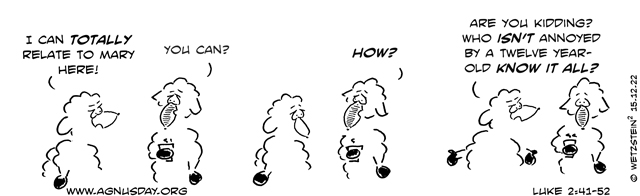
The one account of Jesus’s young life to be found in the canonical gospels is a story that is at first glance remarkable for being rather ordinary on its surface. There’s nothing particularly miraculous or glamorous about it, from our perspective just two days after hearing the Nativity story on Christmas Eve. The context here is twelve years later by which time Mary and Joseph are parents of twelve-year-old Jesus and some younger children, who experience a horrifying moment: their oldest child is apparently lost in the big, frightening city of Jerusalem.  

Luke tells us the family traveled to Jerusalem every year to observe the Feast of the Passover. This year was no different than the years before, evidently; the family gathered itself up and made its way to Jerusalem, in the company of relatives and other faithful acquaintances, for the Passover observance; they remained in Jerusalem for all the appropriate events of the festival, and when it was all over, they, along with their relatives and fellow travelers, made their way home. All very typical of a devout Jewish family of the time, this was.

Only after a day’s return journey towards Nazareth did the story take its unexpected turn. Maybe in our extremely cautious age, where parents can keep children on leashes or attach beepers to them or track them on their iPhones, this story is hard to believe, but a day into the journey home it became clear that Jesus wasn’t there. He was nowhere to be seen. 

The sense of panic Mary and Joseph must have experienced is probably not hard for you to imagine. Emotions rise to a fever pitch, desperation sets in. And there’s no 911 to call, no Amber Alerts to issue; he’s just … gone. At last the only answer is for Mary and Joseph to retrace their steps to Jerusalem and try to find the boy.

Jerusalem is a large city, even at the time in which Mary and Joseph are searching. The frustration of wondering how this boy, normally such a good boy, could go off and do something so irresponsible was no doubt mixing with the sheer terror of desperately trying to find the boy before it was … too late. He’s not at the lodging. He’s not at the market.  Where could that boy be???

Finally, after three days of searching, the parents arrive at the Temple. Sure, this was where no doubt the family had spent much of their time during the Passover, but why would Jesus come back here with the festival over? And yet that’s exactly where Jesus was. Lost in Jerusalem? Not exactly.

Seated among the teachers in the Temple, far removed from the celebrating crowds that had thronged there only a few days before, was the boy Jesus. Luke tells us he was listening to the teachers and asking them questions, and that those hearing him were extremely impressed, to say the least, by his questions, by his attentiveness, by his intelligence, by his insight. 

Not surprisingly, though, the parents are not really in the mood to be regaled with stories of their son’s intelligence and perceptiveness. No, the first thing on their minds, perhaps first after OhthanktheLordhe’ssafe, is “HOW COULD YOU DO THIS TO US???” Luke describes the parents as “astonished,” or “astounded” – but not in a good way. Child, why have you treated us like this?  Look, your father and I have been searching for you in great anxiety. Now let’s put that in terms we can understand: Oh, Jesus, how could you put us through this?  Your poor father and I have been searching all over Jerusalem for you, and you’ve just had us worried sick! What were you thinking, son? How could you just go off on your own like this? Don’t you know it’s not safe?  

At this point it’s impossible to speculate what kind of response Jesus’s parents expected from him. Maybe Mary and Joseph themselves didn’t even know what to expect, or perhaps they expected no response at all, or maybe they didn’t care as long as he was quiet and did what he was told and took his scolding and didn’t sneak off again. 

They most certainly did not expect the reply they got, though. That much is certain.  “Why were you searching for me? Did you not know that I must be in my Father’s house?”  Why would you think I’d be anywhere else? The words must have cut like the sharpest of knives. How long had it been since Mary and Joseph thought back to those events of twelve years before, the strange angel apparitions and stars and shepherds?  No matter what Mary and Joseph thought, Jesus wasn’t lost in Jerusalem; he was right where he needed to be.

For all the seeming disconnect between parents and child, in the end Jesus was obedient, Luke tells us; he went home with Mary and Joseph, his mother and his earthly father, and if there were any similar incidents in Jesus’s teenage years Luke does not tell us about them.

What we learn of Jesus in this account is disconcerting and disorienting for us. At the age of twelve, on the cusp of manhood in the Jewish tradition, Jesus has made his own declaration that, ultimately, he would be going into his Father’s business. Above all else, this twelve-year-old boy tells us, he is the Son of God; and this above all determines where he must be, what he must do, how he must live. Even as we’re told that Jesus grew up well and was well-regarded by those who knew him or met him, the overriding and unbreakable marker of his life was to be in favor with God, no matter how much his parents might not understand, or his brothers or sisters, or his fellow citizens of Nazareth.  

The biblical scholar R. Alan Culpepper describes two ways of understanding obedience to God, saying:

Some define their religious practices with lists of things they may not do: “thou shalt not … “.  Such lists set boundaries, but they do not define goals. A commitment to God that is born of the experience of God’s love and presence is expressed in grateful participation in God’s redemptive work. There are some things we have to do just because of who we are: “I must be about my Father’s business.”

In the end, that’s what we are given to learn from the youth Jesus. No matter how much others – even one’s own family – might misunderstand or resist, if we are truly to be about our Father’s business, there are things we must do, not because they are written down in a list of rules or held over our heads as threats or dangled before us to entice us towards some reward. 

To be sure, there are plenty of “Christians” who live exactly that way and by that reasoning and are quite eager to enforce those strictures on others. Let us be clear on this one thing: folks who live as “enforcers for Christ” are the ones lost in Jerusalem. That’s not why we do what God calls us to do.

No, we do these things because being a child of God means we do these things – we love God’s children, we care for those poorer than we, we worship when we’d rather be sleeping in, and we teach our children what it means to be a child of God even at the risk of their taking it seriously. To borrow words from our confessional document, A Brief Statement of Faith, we pray without ceasing, we witness among all peoples to Christ as Lord and Savior, we unmask idolatries in church and culture, we hear the voices of peoples long silenced, and we work with others for justice, freedom, and peace. And we do it because we must, because that’s what it means to be a child of God, and because that’s what it means to be going about our Father’s business.

Thanks be to God. Amen.

Hymns (from Glory to God: The Presbyterian Hymnal): #132, Good Christian Friends, Rejoice; #138, Who Would Think That What Was Needed; #136, Go, Tell It on the Mountain 


Meditation: Silent Night, Noisy Days

Grace Presbyterian Church

December 24, 2021, Christmas Eve 

Luke 2:1-20

Silent Night, Noisy Days

Do you like my shirt?

For those who can’t see this, I’m wearing a shirt decorated with scenes from the perennially popular Christmas television special A Charlie Brown Christmas. There are a lot of different images here, from Linus and Charlie Brown out looking for trees, Snoopy’s decorated doghouse, Linus resuscitating the wilted tiny tree near the end, and even the infamous dance party that breaks out at rehearsal. You can tell these are really taken from the special, because that scene includes such later-forgotten characters as Shermy (“I always end up being a shepherd”) and the anonymous twin girls who never show up again, dancing that strange head-flopping-side-to-side dance that must surely have caused concussions.

It doesn’t, however, include the best scene: answering Charlie Brown’s dismayed cry “Can’t anybody tell me what Christmas is all about???”, Linus takes the stage and, to dimmed lights, recites presumably his lines for the play, which begins with verse 8 of our reading from Luke today. It is easily the most arresting moment of the special.

It is not, however, the only time Linus spoke Luke 2 on television. In 1992 came a second Christmas special, It’s Christmastime Again, Charile Brown. It’s not on the level of the original – it drags in spots and can be strangely repetitive – but it does have one very telling moment that echoes the original.

Sally, the hardcore Christmas materialist, wonders loudly what the whole point of Christmas is anyway – a slanted echo of her big brother’s cry. Linus, who just happens to have his Bible in hand, starts to read from the same passage as before. In this case, tough, Sally is clearly not really listening. At random intervals Sally keeps blurting out random blurts, total non sequitir, drowning out Linus’s earnest reading of the angel’s announcement to the shepherds with such wonderings as whether she could find a gift to give her brother without spending any money. Finally he gives up mid-story in a frustrated huff. Sally responds at the last “Is that all? I thought the Christmas story was longer.

If that scene from the original Charlie Brown Christmas was the most inspirational moment of that show, this scene from the later program is easily its most real. On some level I think every preacher can relate to that moment this time of year. Seriously, try to speak this snatch of scripture out in the layers of stuff that goes on in the name of “Christmas” out there. Between endless replayings of “It’s the Most Wonderful Time of the Year” or other such holiday numbers, big parades or parties or goodness knows what, it’s very easy for Luke’s picture to get just as drowned out as poor Linus was by Sally. 

We can’t always say the church does much better, though. Tempered by pandemic cutbacks as they might be, many churches surround the event with so much stuff – great big musical presentations, pageants that only serve the purpose of getting people to “ooh” and “aww” at the children – that the message gets drowned out amidst all the stuff attached to the message. It’s hard to sing “Silent Night” in the midst of such noisy days.

With that in mind, I will seek, in this quiet moment, to take my own advice and shut up, and let the story (in Linus’s King James version) be spoken:

And there were in the same country shepherds abiding in the field, keeping watch over their flock by night.
And, lo, the angel of the Lord came upon them, and the glory of the Lord shone round about them: and they were sore afraid.
And the angel said unto them, Fear not: for, behold, I bring you good tidings of great joy, which shall be to all people.
For unto you is born this day in the city of David a Saviour, which is Christ the Lord.
And this shall be a sign unto you; Ye shall find the babe wrapped in swaddling clothes, lying in a manger.
And suddenly there was with the angel a multitude of the heavenly host praising God, and saying,
Glory to God in the highest, and on earth peace, good will toward men.

Thanks be to God. Amen.

Hymns (from Glory to God: The Presbyterian Hymnal): #133, O Come, All Ye Faithful; #113, Angels We Have Heard on High; #123, It Came Upon the Midnight Clear; #119, Hark! The Herald Angels Sing; #122, Silent Night, Holy Night!


Sermon: From Bethlehem

Grace Presbyterian Church

December 19, 2021, Advent 4C

Micah 5:2-5a; Luke 1:39-55

From Bethlehem

Let’s do a little experiment for a moment with this reading from Micah. Imagine for just a moment hearing this:

But you, O Hodgenville of Kentucky,

who are one of the little towns of Kentucky,

from you shall come forth for me

one who is to rule in the United States…

For the most part I’d suspect that the largest number of people would respond to such a proclamation with a puzzled expression and a grunted “huh?” For many people it just wouldn’t make any sense at all. They might wonder if Hodgenville was some kind of tobacco-growing town, or if perhaps it was one of the towns hit by that horrible tornado outbreak a couple of weeks ago (as opposed to the severe weather outbreak just this past week).

For some, though, that pronouncement would be freighted with history. You see, Hodgenville, Kentucky holds the distinction of being the birthplace of Abraham Lincoln, or at least the closest town to that reported site. There’s a quite nice national historical center set up there that tells you the whole story and includes a replica of the cabin in which he was born. Lincoln, of course, was the sixteenth president of the United States, the president who served through the US Civil War, and who virtually always ends up either no. 1 or no. 2 on any list of the top US presidents in history. For folks who know this connection, the invocation of Hodgenville evokes a significant history and importance.

The parallel is not exact by any means, but perhaps it suggests something of what Micah’s hearers and readers would have experienced at the proclamation found in the first two verses of this reading. The mention of Bethlehem, which Micah even notes is from one of the smaller clans of Judah, would have meant little to, say, the region’s Assyrian foes who dominated Judah and Israel by extracting heavy financial tributes, nor would it have meant much the Babylonian emperors or armies that had hauled off numerous people into exile. It might have sounded vaguely familiar as a central town in the part of Judah that produced much of the region’s wheat, but otherwise, it didn’t mean much, most likely.

But to the people of Israel and Judah, those who knew their history, the name Bethlehem meant much, much more. It was, of course, the town from which David, regarded as the greatest king of Israel, had come. In that light a prophecy that “one who is to rule in Israel” was going to come out of Bethlehem immediately brought up all sorts of memories and associations with the great King David and tremendous expectations for this one whose coming was being proclaimed. 

Verse 4 of this reading only amplifies those expectations, describing the promised ruler as one who “shall stand and feed his flock in the strength of the Lord,” as one under whom the people “shall live secure,” one who “shall be great to the ends of the earth” and who “shall be the one of peace.” Strong expectations, indeed, in a land that had known mostly foreign domination and exile for many, many years.

Prophetic oracles, such as this one from Micah and others we have heard across this Advent season, gave hope to the peoples of Israel and Judah across exactly those kinds of dark times, and darker times yet to come. The region continued to be dominated by foreign powers until at last the Roman Empire became the ruling outside force in the region, now given the name Palestine and divided up into smaller units for greater control. 

It is in this context that the reading from the gospel of Luke takes place, as Mary comes to meet her relative Elizabeth. Of course, both women are bearers of miraculous children; Elizabeth is soon to deliver John at this point, with her husband’s angel-induced muteness looming in the background, while Mary’s own angel-announced pregnancy is moving along as well. As Mary arrives the Holy Spirit gets busy, and first Elizabeth and then Mary are given things to say. 

Elizabeth’s exultation should not be overlooked; she knows exactly what child Mary is carrying. While she acknowledges this, her blessing is very much for Mary, naming her “blessed among women” and naming Mary’s willingness to believe what she had been instructed by God through Gabriel the angel. 

Mary’s song, on the other hand, is all about the God who is doing all these marvelous things. The “strength” invoked in Micah’s oracle does make an appearance in Mary’s song – “He has shown strength with his arm” – but there’s a lot more about things like mercy in this proclamation; not just in verse 50’s direct claim about God’s mercy for those who fear him or verse 54’s remembrance of mercy, but more indirectly in God’s favor in looking upon “the lowliness of his servant,” or lifting up the lowly and filling the hungry. 

It’s all fine and good, perhaps, until Mary starts singing about things like God bringing down the powerful or sending the rich away empty. Even in a land dominated or occupied by foreign powers, there were still going to be rich people within those occupied borders. Perhaps they got that way by collaborating with the occupiers, or just taking advantage of conditions to get ahead, or who knows how. In any case, such a person would not take this Magnificat as good news. Nor would a person for whom power is life, whatever kind of “throne” they might occupy or seek. For that matter, even “the proud,” however that term might be defined, come under sanction in this song. 

At this point Mary is unlikely to be thinking anything about Bethlehem. She’s from Nazareth, after all. She and Joseph both live there. Nobody has said anything about a great empire-wide census or registration that was going to require folks to get up out of their current dwellings and go back to their ancestral towns and cities. But that decree is coming, and as a result Mary and Joseph (who we will learn is of the lineage of David) will be in Bethlehem by the time this child is born, and prophetic oracles like Micah’s will come into play. 

So many words over so many centuries became attached to this child, the one who ended up born in the seemingly nondescript but historically magnified little town. So much weight of history, so much hope and expectation, so much crying out for relief, for comfort, for mercy. 

We are so often misled about where to seek such things. We live in a society that is not dominated by a foreign power, despite the efforts of some. We still, though, can be easily confused about where to look for hope. We get bamboozled by fame, or the bright lights of the big city, or any number of other willing distractions. We look for answers to our troubles in Washington, or New York, or possibly Los Angeles, and discount with a laugh the idea that anything good could come out of a place like Hodgenville, Kentucky. Or, for that matter, Gainesville, Florida. 

God works in the margins. God shows up in the least-expected places. God moves in and through folks from no-account towns, or folks from the “wrong side of the tracks” in the big city, or any number of places that don’t look like much from the outside but have their own hopes and heritage and history. God moves not just in mysterious ways, but in places we don’t remember to look, or don’t choose to look. 

You see, the challenge for us is to remember what to look for rather than getting caught up in the where to look. We need to be looking for the one who stands and feeds the flock in the strength of the Lord. We are challenged to behold the one who looks with favor on the lowly, who shows mercy over the many generations, who brings down the powerful and lifts up the lowly, fills the hungry with good things, who remembers promises. And that one shows up sometimes in the least-expected places. 

For the little places where God acts, Thanks be to God. Amen.

Hymns (from Glory to God: The Presbyterian Hymnal): #87, Comfort, Comfort Now My People; #100, My Soul Cries Out with a Joyful Shout; #97, Watchman, Tell Us of the Night


Meditation: What They Leave Behind

Grace Presbyterian Church

December 19, 2021, SWH

Psalm 102:1-11; Acts 9:36-39

What They Leave Behind

Psalm 102 is one of those psalms that feels a little too on-the-nose when we suffer times of grief or distress. The extremes of physical malady even to the point of withering away like grass, the sense of being persecuted or tormented in some way, the way nothing tastes right; all of these are more accurate, probably, than we want to let on. This of course follows a direct, urgent plea expressed in the simplest terms in verse 1: “Hear my prayer, O Lord; let my cry come to you.”

In particular, it seems that a time of grief, especially grief at the loss of a loved one or grief at some new ominous diagnosis, seems to throw everything askew. Nothing sounds right, nothing looks right, nothing tastes right or smells right or feels right. Everything is off. Nothing works.

And if you’ve ever gone through such losses, you know that the smallest or most unexpected things can set off those sensations or reactions in ways for which we simply cannot be prepared. Yes, words or silences or music or any number of such, but also actual physical things, items, objects that in some way are connected to the one we’ve lost. Some object, ordinarily nothing special, sets us adrift in grief again maybe in a moment when we thought we had achieved a brief rest or equilibrium. 

That’s perhaps the most striking thing in this account from Acts, after the death of Tabitha (also known as Dorcas). It might feel a bit of a cheat to use this passage in a service like this one, as just a few verses later Peter will raise the woman from the dead. But this moment caught in verse 39 leaps out, unique in the scriptural accounts of situations anything like this. The ones who are present, grieving this loss, do not (as far as we are told) actually say anything to Peter; instead, they show him pieces of clothing she had made with them, or maybe for them, in her lifetime. They show Peter the things she left behind.

This time of year, perhaps this coming week specifically, can be a time when those things left behind strike deepest. The place at the table; the old sweater; the slippers; the favorite chair; it can be anything. The grief rises. 

In truth, such grief never truly goes away. It doesn’t always manifest itself so painfully, and with time even takes on a tinge of joy, joy at the memory of the one we’ve lost. The objects either are eventually discarded in some way or saved for particular memory-making. We live, not without grief, but with grief transforming into something that is part of life itself. 

One of the most thoughtful words spoken about grief in the past year really did come from a television show based on characters from superhero comic books. I am not making this up. I won’t even try to provide background or context – we would be here all evening – but simply state it: “But what is grief, if not love persevering?”

It stands out for provoking us to understand our grief differently. Those things they left behind become not merely spikes of pain, but reminders of the love we knew for that person. The pain, ultimately, does not endure. It may flare up on round-number anniversaries or other such provoking occasions, but it does not become the permanent state of life – not when that grief is borne of love. We love; we feel the pain, but we continue to love. And the things they leave behind remind us of that love, and if we’re doing it right, remind us to love more. 

For the things they leave behind, Thanks be to God. Amen.


Sermon: Rejoice? Now?

Grace Presbyterian Church

December 12, 2021, Advent 3C

Zephaniah 3:14-20; Philippians 4:4-7Luke 3:7-18

Rejoice? Now?

Today, the third Sunday of Advent, is sometimes known as “Gaudete Sunday.” “Gaudete” is the Latin word for “rejoice,” and has for generations appeared as the first word of the introit of the Latin mass for the day. The appointed lectionary texts for the day tend to reflect that imperative call to “rejoice,” and the procession of purple candles in the Advent wreath is interrupted on this day by a pink candle, suggestive of a slight lift in an otherwise penitential or at least reflective season.

You can hear the rejoicing in at least two of the texts we have heard this morning. Leave it to John the Baptizer, out in the wilderness, to be the exception. You’re not going to look for a call to rejoice in a text that starts with John calling some of his hearers “You brood of vipers!”. Rejoicing isn’t John’s thing; straight-up call to repentance and change of life is his work and he doesn’t let up in the face of anything. The two outer portions of this passage feature John at his harshest. Besides the “brood of vipers” invective in part one, he swats down the “children of Abraham” privilege defense his hearers were likely to claim before they even had a chance to claim it, with the pithy observation that God could raise up “children of Abraham” out of the stones on the ground. Then he conjures up the image of an axe ready to cut down trees that don’t bear fruit. The third part invokes separating wheat and chaff, with the latter consigned to fire.

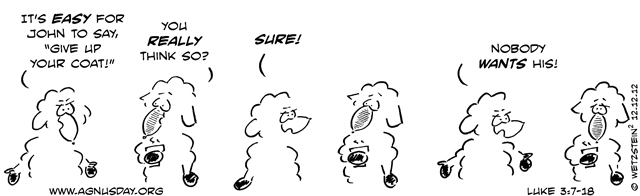
The middle section might not rise to the level of rejoicing, but it at least contains good instruction to those who would hear. It’s also specific instruction; what the tax collectors were challenged to do was not the same thing as what soldiers were challenged to do. In each case, they were called out for the abuses associated with their profession and told to stop it. For all, the challenge was most basic: share with those who don’t have. Notice that John isn’t telling everyone to give everything away; keep one coat for yourself but give one to the person who doesn’t have one. Not quite rejoicing, but solid instruction to build upon, and potentially a source of joy in the doing.

The snippet from Paul’s letter to the Philippians, on the other hand, puts the “rejoice” imperative right up front. Notice, though, that this isn’t written as a part of some enthusiastic outburst of praise. No; the way the passage is structured, the call to “rejoice” is but one instruction among many. Paul follows by telling his readers to be gentle, know that the Lord is near, don’t worry about stuff, but pray and make your requests to God with gratitude. The quick sequence of instructions is wrapped up with a promise, and a beautiful one at that: “And the peace of God, which surpasses all understanding, will guard your hears and your minds in Christ Jesus.”

For the real outburst of rejoicing on this Gaudete Sunday, you have to go to that reading from Zephaniah, another one of those short prophetic writings from the tail end of the Hebrew Scripture we find in our Bibles. What we have here is the end of that book, and what a passage it is! Amidst all the calls to sing and shout and rejoice comes the word that “The Lord, the King of Israel, is in your midst” in verse 15, and “The Lord, your God, is in your midst” in verse 17. And look at the promises in this finale; 

  • God will take away the judgments against you (15);
  • Remove disaster, so that you will not be judged for it (18);
  • Deal with your oppressors, save the lame, gather the outcast (19);
  • Bring you home, make you renowned and praised, restore your fortunes (20).

It is big, it is bold, it is exuberant – the whole image that God “will exult over you with loud singing as on a day of festival” in verses 17-18 is just wonderful to contemplate. It is a beautiful and exuberant song of rejoicing that is so utterly and completely out of place in the context of the rest of this book. 

As short as Zephaniah is, I don’t think I have time to read the entire book here in the sermon. So to give you an idea, here are a few choice moments from the book. Take the very first chapter. Verse one is an introductory statement, and then come verses 2-6:

I will utterly sweep away everything from the face of the earth, says the Lord. I will sweep away humans and animals; I will sweep away the birds of the air and the fish of the sea. I will make the wicked stumble. I will cut off humanity from the face of the earth, says the Lord. I will stretch out my hand against Judah, and against all the inhabitants of Jerusalem; and I will cut off from this place every remnant of Baal and the name of the idolatrous priests; those who bow down on the roofs to the host of the heavens; those who bow down and swear to the Lord, but also swear by Milcom; those who have turned back from following the Lord, who have not sought the Lord or inquired of him. 

Encouraging, yes?

How about verses 17-18 from that same chapter: 

I will bring such distress upon people that they shall walk like the blind;because they have sinned against the Lord, their blood shall be poured out like dust, and their flesh like dung. Neither their silver nor their gold will be able to save them on the day of the Lord’s wrath; in the fire of his passion the whole earth shall be consumed; for a full, a terrible end he will make of all the inhabitants of the earth.

Chapter 2 directs the same kind of thing against Israel’s enemies, and chapter 3 turns the focus back to Jerusalem before the lift at the end of the chapter. But hopefully you get the idea. You can see, hopefully, just how jolting that song of rejoicing at the end is in the context of all that has come before. It’s jolting enough that some scholars are convinced that 3:14-20 was not original to Zephaniah but added by a later editor. 

Part of the uncertainty has to do with whether Zephaniah was written while Israel was still in exile in Babylon, or after they had returned to the the barren and broken-down land of Israel. Either way, neither is a situation that suggests rejoicing. In the one, you can only dream of home from far away; in the other, you can only dream of home even though you are home. 

And yet, whichever bleak and seemingly hopeless situation the people were in, the song is of rejoicing. The rejoicing doesn’t wait; rejoicing trusts in the promises of God, the goodness of God, the love of God, the nature of God, and takes assurance that the deliverance of God will come. 

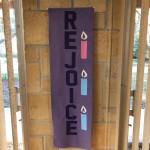
It’s not unrelated to why this particular Sunday, “Gaudete Sunday,” happens now, before we get to the end of Advent. I forget who it was that asked me, a couple of years ago when we first began to use these banners in worship for Advent, why the “rejoice” banner came before the “behold” banner that will be placed next Sunday. It turns out our rejoicing isn’t based on seeing; rejoicing comes by faith. It comes by trust. It comes from dwelling in God and knowing God’s promises for us, God’s love for us

I don’t quite think our situation is quite so bleak and desperate as the one in which Zephaniah’s original hearers lived, whether they were in exile or returned from it. It ain’t great, though. And yet the exaltation to rejoice, the invitation to rejoice, even the command to rejoice isn’t nullified by any adverse circumstances. We rejoice in God not because of any one thing we see, but because of who God is: a God faithful and just to forgive us our sins, a God who love us enough to rejoice over us with loud singing, a God who fulfills promises, a God who delivers. In the goodness and faithfulness of God, the God who shows us the Promised One coming, we rejoice. And not just on Gaudete Sunday.

For a God in whom to rejoice, Thanks be to God. Amen.

Hymns (from Glory to God: The Presbyterian Hymnal): #83, Come, Thou Long-Expected Jesus; #96, On Jordan’s Bank the Baptist’s Cry; #102, Savior of the Nations, Come

A humorous take on John’s instruction…


1 Comment

Sermon: What a Father Sees in a Son

Grace Presbyterian Church

December 5, 2021, Advent 2C

Malachi 3:1-4; Luke 1:68-79

What a Father Sees in a Son

There aren’t really any verses in the book of Malachi that are famous. Micah has that passage reminding us that what the Lord requires of us is “to do justice, to love kindness, and to walk humbly with your God”. Amos, for all his seeming hot-tempered prophecy, finds the moment even in one of his fierier passages to invoke the call to “let justice roll down like waters, and righteousness like an ever-flowing stream”. But really, there’s no such passage in Malachi, the final book in Hebrew scripture.

If any reading in Malachi is reasonably well-known, it’s probably the one we just heard a few moments ago. You might not recognize it in spoken form, however. But a portion of this passage was lifted by Charles Jennens, an eighteenth-century gentleman of London and sometime creator of librettos for operas or oratorios. He worked these verses into an extended passage featuring baritone solo and chorus, as it would eventually be set by his frequent collaborator George Frideric Handel, in the work that would become the oratorio Messiah. This passage includes most of that first verse and substantial portions of the three remaining verses (in King James Version text, of course). 

Naturally, though, the portion of this passage that most fits today’s message is the very first part of the first verse, that Jennens and Handel did *not* use: “See, I am sending my messenger to prepare the way before me…”. While many passages of Hebrew Scripture are read as foretelling a coming Messiah, here is one that seems to point to that Messiah’s Forerunner, the one known as John, the baptizer and wilderness preacher whose first appearance as recorded in the gospel of Luke would be found in the regular gospel reading for today.

We are offered today, though, as a canticle (a reading offered in the place of a psalm reading) that also points to John’s ministry on earth. It is the blessing exclaimed by a priest named Zechariah, John’s father, upon John’s birth. That requires some backstory, from the first chapter of Luke

Once while preforming his priestly duties in the Temple Zechariah was visited by the angel Gabriel (this was before that angel would visit a young woman named Mary). The angel had an announcement for old Zechariah: he and his wife Elizabeth, who we are told had no children and “were getting on in years,” were to have a child, a son. Gabriel gave Zechariah quite a lecture about the boy, with perhaps the most key part being that he was to be named John (this becomes important later). 

Zechariah, who seems to be mostly knock-kneed scared at all this, does what might seem natural in the face of such a revelation: he wonders out loud how that can possibly happen. Gabriel seems to take personal offense at this, and basically hits the mute button on Zechariah; the old priest is rendered unable to speak “until the day these things occur.” (Evidently Gabriel learned to control his temper by the time he visited Mary, who also responded to Gabriel’s announcement with a question, “How can this be?”) When the people at the Temple see Zechariah gesticulating about wildly but unable to say anything, to say the least they knew something unusual had happened. He went home and, sure enough, his wife Elizabeth conceived.

Fast forward nine months, and sure enough, Elizabeth gives birth to a son, and there was great rejoicing among their friends and neighbors. When it came time for the child to be circumcised and named, though, there was trouble. These neighbors seemed to think they had anything to do with naming the child and were going to name the boy after his father. Elizabeth’s protestations were dismissed because “none of your relatives has this name.” Finally someone handed Zechariah a writing tablet and asked what the boy’s name was to be. Zechariah wrote “His name is John.” Hebrew doesn’t have exclamation points, but if it did I’d imagine Zechariah would have used several of them after that foolishness. Sure enough, as soon as the boy’s name was established, Zechariah was un-muted and able to speak: our reading today is what he said first. Our first hymn today was an adaptation of this blessing.

In form and structure it’s a lot like many traditional blessings with a touch of the prophetic to them in Hebrew tradition, not surprising for an old priest who had likely been studying and praying and teaching such blessings all his priestly career. You’ll also note most of it looks forward to a savior being lifted up for the house of Israel. It’s a passage that would not be out of place in any number of prophetic writings we find in Hebrew Scripture. At least, it wouldn’t be out of place until verse 76, when Zechariah breaks away from being the old priest and lets himself be brand new dad. 

You have to imagine his face softens a little, and perhaps he looks down at the boy, maybe is even holding the boy by now. For all his fear at Gabriel’s appearance, Zechariah apparently did remember what he had been told; this child would be “called the prophet of the Most High, for you will go before the Lord to prepare his ways, to give knowledge of salvation to his people by the forgiveness of their sins.” That’s a huge expectation for a child barely born. Zechariah, after his months of enforced silence, can say what he has been given in this child. 

We can say what Zechariah sees in his son. It’s hard not to wonder, though, what Zechariah can’t see for John. Even in verse 80, the final verse of this very extensive chapter, we are already told that John “was in the wilderness until the day he appeared publicly to Israel.” With both Zechariah and Elizabeth “getting on in years,” we can’t know just how much of John’s public career they would live to see. What would they possibly have made of their son making trouble in the wilderness, with his camel-hair coat and his diet of locusts and honey? Is this what Zechariah imagined when Gabriel surprised him in the  Temple with that great announcement? 

There is this strange quality about Advent in that it sets up, in many of its selected scripture readings and prayers and liturgies, grand and glorious expectations. Those expectations, when fulfilled, have this habit of seeming a lot less glorious than previously anticipated. Malachi’s “messenger to prepare the way,” Zechariah’s “prophet of the Most High” to “go before the Lord to prepare his way,” the one the angel said would be “great in the sight of the Lord” and proclaimed that even before his birth would be “filled with the Holy Spirit” turned out to be a crazy guy in the desert with a strange wardrobe and weird diet. Then again, most people probably didn’t expect that Messiah, that mighty Savior, to be born in such a setting that he was settled down in a feed trough in an animal shelter.

Of course, at this point we modern Christians are beyond being shocked by these things. We’ve internalized these stories so much that this is just how the story goes, and we can no longer see how God moves in such unexpected and even subversive ways to accomplish these things. Maybe this little bit of backstory for John might help us to recover the unexpected and rather jolting quality that Advent and Christmas have written all over them, even if we no longer are able to recognize it as such. 

And maybe as a result we might be able to see the jolting things, the things that look disappointing, the things that don’t look glorious or grand to us, are in fact the moving and working of the kingdom of God among us. Even something so inglorious-looking as these things (hold up “miracle meal”). As ungainly or even offensive as it might seem to us, God still shows up. God still moves. We might even learn that a church that has gotten small, that streams its services on an iPad when it gets here (or an iPhone when it doesn’t), and has four art studios on its property, is actually part of that moving, coming kingdom of God, no matter how much it might not look like it.

For Zechariah’s song, and what he saw, and maybe what he couldn’t see, Thanks be to God. Amen.

Hymns (from Glory to God: The Presbyterian Hymnal) #109, Blessed Be the God of Israel; #104, O Lord, How Shall I Meet You?; #106, Prepare the Way


Sermon: Advent, Part II

Grace Presbyterian Church

November 28, 2021, Advent 1C

Jeremiah 33:14-16; Luke 21:25-36

Advent, Part II

Well, here we are again. At the inauguration of a new season of the church, even a new year in the life of the church, with the trappings of the season starting to sneak into our sanctuary, somehow we’re right back where we were two weeks ago; instead of looking backward to the birth of Jesus, as Advent is popularly portrayed, we are looking ahead, into the same apocalyptic discourse we covered then, albeit written by a different gospel writer. Advent does both, we are reminded, and as the scriptures of the season are typically arranged, it looks forward before it turns its gaze to the past. Part II comes before Part I, you might say. It’s a season Doctor Who would love.

Before we plunge into Luke’s version of Jesus’s apocalyptic discourse, it might help to step back into the prophetic literature – not for the apocalyptic predecessors of Jesus’s speech, but to a word of hope given in the midst of an apocalypse in progress. 

For one often called the “weeping prophet,” and one whose name was turned into a descriptive term for the kind of accusatory tirades against wrong that pepper his writing, Jeremiah turns out to have a way with words of hope as well. Chapters 30-33 of this prophetic volume have been known as the “Little Book of Comfort” since Martin Luther’s time, for good reason; amidst the storm of prophetic outrage and the devastation of prophetic warnings fulfilled (and then some), these three chapters speak of comfort, based on the needed reminder that even in the worst of situations the Lord is still acting. 

This particular passage gets its place in Advent mostly because of its promise of “a righteous Branch to spring up for David” who “shall execute justice and righteousness in the land.” It’s not hard to leap to a conclusion (from a much later perspective) that this must somehow be a reference to Jesus, born of the house and lineage of David as the gospels tell us. There are two problems with this; one, it’s misguided to assume that this is the statement Jeremiah means to make, and two, it distracts us from the meat of this passage, the part that actually makes demands upon us.

It is today far too easy to dismiss the word “righteousness” in modern thought. We are frankly more likely to hear the word in combination with the prefix “self-” as a criticism than to hear it on its own. Pastor and biblical commentator Deborah A. Block reminds us that this is a key concept of the coming of Christ as portrayed in Advent: 

…”righteousness” is one of the first words of the language of Advent. In Matthew’s gospel, “righteousness” is Jesus’s first word, spoken to John the Baptist: “Let it be so now … in this way to fulfill all righteousness” (Mt. 3:15). Righteousness is not an attitude or an absolute standard. It refers to conduct in accord with God’s purposes. It is doing the good thing and the God thing: right doing as opposed to wrongdoing, and doing as opposed to being. Self-righteousness is the inflated ego of self-approval; righteousness is the humble ethic of living toward others in just and loving relationships.[1]

Here is the challenge for us in Advent, particularly on this first Sunday when apocalyptic stuff gets thrown at us again. 

The language of this reading from Luke is the kind of stuff that has been lifted by writers and others over the decades to make a quick buck off a best-selling book (or in recent years movies as well). The images are fearful enough; the suggestion of “signs in the sun, the moon, and the stars” is ominous and foreboding; the suggestion of natural disaster run rampant resonates too easily in our own time. After the images of fear and destruction comes the line, found in very nearly these words in Mark’s “little apocalypse” from two weeks ago, that should be the impetus for our reassurance: “Then they shall see ‘the Son of Man coming in a cloud’ with power and great glory.” 

What follows is the part that all those Left Behind books and movies don’t include: “Now when these things begin to take place, stand up and raise your heads, because your redemption is drawing near.” The illustration of the fig tree that follows is one we can grasp well enough if we substitute a tree more familiar in these parts; when it sprouts leaves and turns green, you know what season is coming. Likewise, when we see these signs that have been laid out in this chapter, we know that “the kingdom of God is near.” 

To borrow a line from Mark 13, all those signs are only “the beginning of the birth pangs.” And Luke, like Mark, makes sure to remind us that everybody on the earth will see it come – no getting lifted away to miss the bad stuff. And yet the directions are the same: be on guard, keep watch, be awake. Pray for strength to endure it all and to be ready to “stand before the Son of Man.” After all, the very word “apocalypse” that we have so associated with destruction and chaos is in fact derived from a Greek word that means “unveiling,” “revealing,” or “revelation.” That’s how that last book of the New Testament got its name. And this reminds us that for all the fearful imagery in these apocalyptic readings, the point of it all is revealing – revealing the Son of Man, revealing the kingdom of God coming near. Revelation, not destruction.

Here’s where Jeremiah’s words connect. To live in the righteousness of God – not that nasty self-righteousness we rightly condemn, but the real thing – is going to be the thing that keeps us ready and mindful and watchful and aware as the signs of the approaching kingdom of God keep piling up. And we need to be reminded of this now, right at the beginning of Advent, lest we mistakenly start to think that the coming birth of the Messiah is the end of the story.

What we commemorate in Advent, the birth for which we prepare and celebrate, is a beginning, not an end. And for that matter, the events of Holy Week that come along in a few months, even including the Resurrection we celebrate on Easter Sunday, are not an end either. Seeing the working of God in the world will require great endurance on our part, doing justice and righteousness and being on guard and keeping watch while the signs of the times keep unfolding. 

Another biblical commentator, Michal Beth Dinkler of Yale University, summarizes our task as the season of Advent leads us towards the Christmas event:

As we move into the Christmas season, let us not get so myopic in single-mindedly over-preparing for Christmas that we forget God’s vision for the world — a vision that is God’s to control, a vision that is far broader and more expansive than either/or thinking can allow. What is at stake is not just another annual celebration or making Christmas memories with friends and family. What is at stake is the coming of the kingdom of heaven, which, Jesus reminds us, is both already and not yet here.[2]

Even that birth we will celebrate ere long points to this coming and here and now and not-yet kingdom of God. For all our sentimentality over the event, it is the challenge that follows that we need to take from and live into during this and every Advent season. Living in God’s justice and righteousness; that’s how we remain on guard and keep watch for the coming of the Son of Man, in power and great glory.

For even the challenging and difficult words of scripture that are, after all, words of hope, Thanks be to God. Amen.

Hymns (from Glory to God: The Presbyterian Hymnal): #129, Lo, How a Rose E’er Blooming; #357, The Days are Surely Coming; #348, Lo, He Comes with Clouds Descending.


[1] Deborah A. Block, “Pastoral Perspective” commentary on Jeremiah 33:14-16, in Feasting on the Word: Preaching the Revised Common Lectionary, Year C, Volume 1, David L. Bartlett and Barbara Brown Taylor, general editors. Louisville: Westminster John Knox Press, 2009, 6. 

[2] Michal Beth Dinkler, Commentary on Luke 21:25-36, Working Preacherhttps://www.workingpreacher.org/commentaries/revised-common-lectionary/first-sunday-of-advent-3/commentary-on-luke-2125-36-4 (accessed November 23, 2021).


1 Comment

Sermon: Signs of the Times

Grace Presbyterian Church

November 14, 2021, Pentecost 25B

Mark 13:1-8

Signs of the Times

Every lectionary cycle ends basically the same way. The final Sunday of any lectionary cycle is celebrated as Christ the King or Reign of Christ Sunday. What happens the Sunday before that, however, can be a bit wild. 

Year A, on the gospel of Matthew, culminates with the barrage of parables Jesus lets loose in Matthew 25, just before all Hell breaks loose, in about as literal a sense as that phrase can be used, in chapter 26. Mark and Luke, on the other hand, choose to put forth a bit of apocalyptic teaching from Jesus. (Matthew also includes such an apocalyptic discourse from Jesus, but the lectionary framers chose not to include it; apparently two years out of three is enough.) Curiously, the next lectionary cycle will also touch on an apocalyptic theme; we will be on to the gospel of Luke at that point, but the text will address Christ’s return, “‘the Son of Man coming in a cloud’ with power and great glory.” Don’t worry, after this you won’t have to hear about apocalypse for the rest of the lectionary year. 

But here, following directly after the account of the poor widow and her all-she’s-got offering comes this seemingly out-of-nowhere discourse from Jesus on What to Expect When the End Is Coming. As unfamiliar and different as it may seem, though, it is prompted by something very familiar in Mark’s gospel; a disciple vocally and obviously Not Getting It.

Hot on the heels of Jesus’s denunciation of the power structure of the Temple and its exploitation of those who partake in its worship, one of the disciples (mercifully unnamed) goes off in a tizzy over the Temple building itself: “what large stones and what large buildings!” Jesus ends all discussion with the blunt assessment “Not one stone will be left here upon another; all will be thrown down.” Only when the group has reached the Mount of Olives do Peter, James, John, and Andrew (something of an executive committee of the disciples) dare to ask Jesus for an explanation.

There is a bit of history, though, that can keep us on track here and keep us from going off on apocalyptic tangents too soon. While you can get a good argument among biblical scholars on the exact date, those scholars agree that Mark’s gospel was written some uncertain time around the year 70 – maybe a little before, maybe a little after. That date is very significant, as it was the year that, after extended conflict between Judean rebels and the imperial Roman occupiers of Judea, the Romans destroyed the Temple and much of Jerusalem. Jesus’s words here as recorded by Mark are describing an event that either is imminent or has just happened. There’s no forth-telling here; Mark’s readers will know exactly what this is about.

The aforementioned four disciples seek an explanation from Jesus on the Mount of Olives, but instead Jesus presses on with more detail and warning. Emilie Townes, biblical scholar and dean of Vanderbilt University’s theology school, summarizes the horrors described like so: 

The ebb and flow of creation as we know it, the relationships we have established, the cultural markers that help define us – these and more are now obliterated. This is total destruction at its sharpest. It is unrelenting and unforgiving, and no one – not even the faithful – can escape its devastating blows as the old age is swept away for the new one.

And that’s just these first eight verses, which Jesus describes as just “the beginning of the birth pangs.” The rest of Mark 13 gets even worse, at least until that appearance of the Son of Man with great power and glory (v. 26). That’s the thing about these apocalypses in the gospels; they end with the very thing we’re looking forward to, right? We long for Jesus to be present among us again, right? 

In the meantime, though, things aren’t easy. And here’s the kicker; no one gets off scott-free, not even the faithful. No one gets raptured away to be “kept safe” in the dark and dangerous times. And yet notice also that there is no “call to arms” here, no summons to battle. There’s nothing here about fighting to save … well, anything. 

What are we called to do, then? Keep watch. Beware. Keep bearing witness to the gospel. Endure to the end. Don’t be led astray by false witnesses or would-be messiahs. Pay attention to the signs of the times. Don’t be stupid enough to think you know when this is all going to happen. And one more time, in verse 37, “Keep awake.

There are two things about this passage we’d do well to remember, lest we get too distressed or hopeless over it all. One: this is not new talk. Frankly, what Jesus is saying here is, more or less, boilerplate apocalyptic with a deep long history in Jewish tradition. And at least in these first eight verses, the events described are, well, not all that uncommon. Would-be messiahs? Check. Wars and rumors of wars? Check. Nations rising against nations, kingdoms against kingdoms? Earthquakes? Famines? Check, check, check. We can certainly claim these things, but so can frankly almost any age.

Point two to remember is found in verse 8: all of this that Jesus describes is but “the beginnings of the birth pangs.” As one who has never experienced nor will experience that particular sensation, I would not dare to comment upon it. However, we have to note that the birth pangs are not the end-all and be-all of pregnancy; birth pangs give way to birth, new life, new love.

So it is with these times. The birth pangs of conflict and trouble give way to the new birth of life in the unending presence of Jesus, the Son of Man coming with great power and glory.

The times of trouble can be stressful indeed. Even the poet William Butler Yeats was struck by the sense of turmoil and discord and the loss of innocence that comes with these, in his poem “The Second Coming”; 

Turning and turning in the widening gyre

The falcon cannot hear the falconer; 

Things fall apart; the centre cannot hold; 

Mere anarchy is loosed upon the world,

The blood-dimmed tide is loosed, and everywhere

The ceremony of innocence is drowned; 

The best lack all conviction, while the worst

Are full of passionate intensity. 

If that doesn’t sound familiar just from a glance at daily headlines, I don’t know what to tell you. And yet…and yet…and yet, here we are promised that for all the birth pangs, for all the trials and conflict and violence, our end is promised in the returning of our Lord among us. 

In the meantime, we endure. We keep listening to the Spirit, we keep studying what we have been given in scripture – not hunting and cherry-picking for stuff that gives us an excuse to do what we want, but taking what Jesus says and learning how to live it, taking what the early church experienced and learned and figuring out what that teaches us, paying attention to those signs of the times without obsessing on them or using them as an excuse to launch a holy war. We endure, we wait, we keep awake, we keep faithful. And we await, even await with joy, what comes after the “birth pangs.”

 Thanks be to God. Amen.

Hymns (from Glory to God: The Presbyterian Hymnal): #352, My Lord! What a Morning; #361, O Christ, the Great Foundation; #629, Jesus, the Very Thought of Thee


Sermon: What Does a Saint Look Like?

Grace Presbyterian Church

November 7, 2021, All Saints’

Revelation 21:1-6a; Mark 12:38-44

What Does a Saint Look Like?

This past Monday, November 1, was All Saints’ Day on the liturgical calendar most typically followed by churches in the western tradition that bother with liturgy and holy days and stuff. In Catholic and to some degree Anglican or Episcopal traditions, the day is given to the remembrance of the saints of the church, in those cases referring to a fairly specific list. Technically the next day, All Souls’ Day, is given to remembering the “saints of the church” who have passed away and are no longer among us, whose absence we mark keenly. Churches outside those traditions (like, um, us) have a tendency to conflate those two traditions into a single event, and to mark it on whatever Sunday nearby happens to be appropriate.

Presbyterians don’t engage in the bestowing of sainthood, although unofficially you could probably persuade a lot of Presbyterians to offer up children’s television host and ordained Presbyterian minister Fred Rogers (you remember, the one with the Neighborhood) for such an honor. All Saints’ Day very much gets conflated with All Souls’ Day. 

Again (not unlike last week), a lectionary reading not assigned specifically to the occasion might have a lot to tell us about the occasion and what we should learn from it. In this case, how Jesus teaches his disciples in today’s reading is fundamentally important for us in a time when it is fearfully difficult to see the “saints” among us.

We are prone to use the word “saint” in one of two ways. One way might be evoked in the reading a few moments ago from Revelation, in which “a new heaven and a new earth,” “the holy city, the new Jerusalem” are seen coming down from the heavens (this is how you know you’re near the end of the book). The description emphasizes the dwelling of God among the people of God in this “holy city,” and the, well, general blissfulness that this involves. Were we to keep reading in that chapter we would come to the physical description of that holy city, a description overwhelmed by words like “glory” and “radiance” with all kinds of jewels mentioned as part of the city’s great walls, with gates made of pearl and a street of “pure gold, transparent as glass.”

I think we tend to have one concept of “saint” being a human personification of such a holy city, one who is impossibly holy and pure and unremittingly good and all that. Such a conception is, frankly, intimidating and not at all viewed as even a little bit achievable.

Our other definition, to put it bluntly, is a little less lofty. Frankly, anyone who manages to get to a certain age and outlive most of their generation, to be the senior member of their community, ends up being regarded as a “saint” in this sense. This tends to apply no matter how cranky or difficult such a “saint” can be at times.

In short, we don’t really know what to do with the word. Back in Mark, Jesus might have some help for us here, but that help might be more about what we are looking for in a “saint,” and how we define what a “saint” is, than in any kind of formal or liturgical definition.

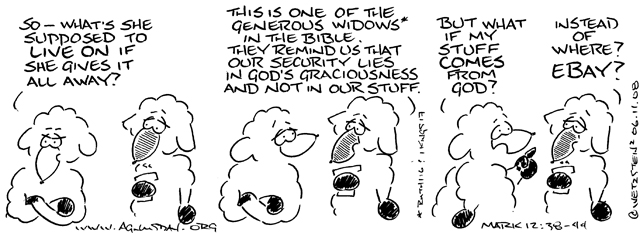
Jesus and the disciples are still at the temple. Despite the positive experience with the scribe we saw in last week’s reading, Jesus has some things to say about other scribes who are definitely, in his view, far, far away from the kingdom of God. These scribes, who were not merely religious figures but also civic and public officials, were all too keen to gather all the perks of their position and use them for their own benefit and glory. That line about devouring widows’ houses and saying long prayers for appearance’s sake unavoidably puts me in mind of certain senators I could name. 

There’s a tendency to assume that what happens next is its own separate story, completely detached from this brief discourse. Our lectionary compliers don’t think so, fortunately, because if anything, Jesus is still teaching in what comes next. He and the disciples move to a different part of the temple complex, where monetary gifts are collected. To be blunt, some of these contributions are, at minimum, performative; the point is as much to make sure others see the gifts being made as to make the gift itself. Quite likely the great sums being brought in by these rich people are the equivalent of loose change we might dig out from between our sofas for some of us – a small portion of our resources that won’t be missed, much the same way the sums of money Elon Musk or Jeff Bezos spent to rocket into the upper reaches of our atmosphere didn’t make any serious dent in their financial holdings. 

The contrast between such displays and the meager gift of the poor widow couldn’t be clearer, but Jesus has something to say about it. Calling the disciples over (who knows where they’d wandered off to), he resumes teaching them. Notice that something we tend to assume about this passage isn’t really there:

Truly I tell you, this poor widow has put in more than all those who are contributing to the treasury. For all of them have contributed out of their abundance; but she out of here poverty has put in everything she had, all she had to live on.

You have to suspect this is one of the widows whose houses were devoured as in the first half of today’s reading. Whether by legal manipulation in their civic/political role, or by spiritual manipulation in their temple role (or some of both), such scribes were able to gobble up the possessions of such powerless individuals ostensibly for the benefit of the temple, or much likely for their own enrichment. One is unavoidably reminded of the Jimmy Swaggarts and Jim Bakkers of the world of televangelism, notorious for (among other things) manipulating viewers into making gifts they couldn’t afford to make. Maybe we even had family members so manipulated and duped. 

This takes us back to Jesus’s words, and what he does and doesn’t say. Jesus does not actually praise the widow for her gift. He points out the contrast between her entire everything and the pocket change of the rich, but he doesn’t specifically say she’s good for doing so. The contrast is even more crushing when one realizes that under the Torah, such an individual should have been regarded as being under no obligation to contribute at all. Some official should have been there to tell her to keep it – she needed it more than the temple did.

Jesus’s point here is not to elevate the widow, whose gift probably went unnoticed by everyone else in the temple, as particularly “saintly,” but to expose just how corrupt and un-saintly those big spenders – the ones getting the “ooh”s and “aaah”s as they dropped in their gifts – were in their meager giving. They gave out of their leftovers. That’s not what a saint does. 

And yet even today we get fooled by this. We get dazzled by those who flash the big bills and belittle those with seemingly nothing to offer. Whether we use the word “saint” or not, we are too easily duped into glorifying those who give from their leftovers and belittling those who give all. 

Having invoked Fred Rogers earlier, it seems appropriate to give him a word at the climax. This is the quote you can find on one of the bookmarks, a few of which are still found in the racks in your pews here and there: 

A high school student wrote to ask, ‘What was the greatest event in American history?’ I can’t say. However, I suspect that like so many ‘great’ events, it was something very simple and quiet with little or no fanfare… . The really important ‘great’ things are never center stage of life’s dramas; they’re always ‘in the wings.’ That’s why it’s so essential for us to be mindful of the humble and the deep rather than the flashy and the superficial.

What applies to events, applies to people. We get seduced by the flashy and the superficial and miss the humble and deep on a regular basis. The greatest saints likely go almost completely unnoticed, except perhaps by those who are touched directly by their sainthood – and maybe not even by them. We tend to look for saints in all the wrong places, and inevitably end up disappointed in those we so anoint. 

There are saints among us, but they’re not walking around with halos over their heads and glowing garments. They’re not walking around in thousand-dollar suits or designer gowns and expensive hairstyles, or even trendy jeans and slick hipster hairstyles. They’re extremely unlikely to be going about getting much attention at all. 

Look for the saints in the margins, where need is greatest, and attention is least. Look for the saints off to the side, giving everything they’ve got while the performative givers are glomming up all the adulation. Look for the saints in the rough places, far from any gates of pearl or streets of gold. 

Look for those marginal, unnoticed saints. That’s what Jesus does.

Thanks be to God. Amen.

Hymns (from Glory to God: The Presbyterian Hymnal): #326, For All the Saints; #708, We Give Thee but Thine Own; #828, More Love to Thee, O Christ